When a friend cancels a trip, who pays their share?
A friend backs out after the booking is paid. Who covers their share, what happens to refunds and replacements, and the rule to agree before you book.
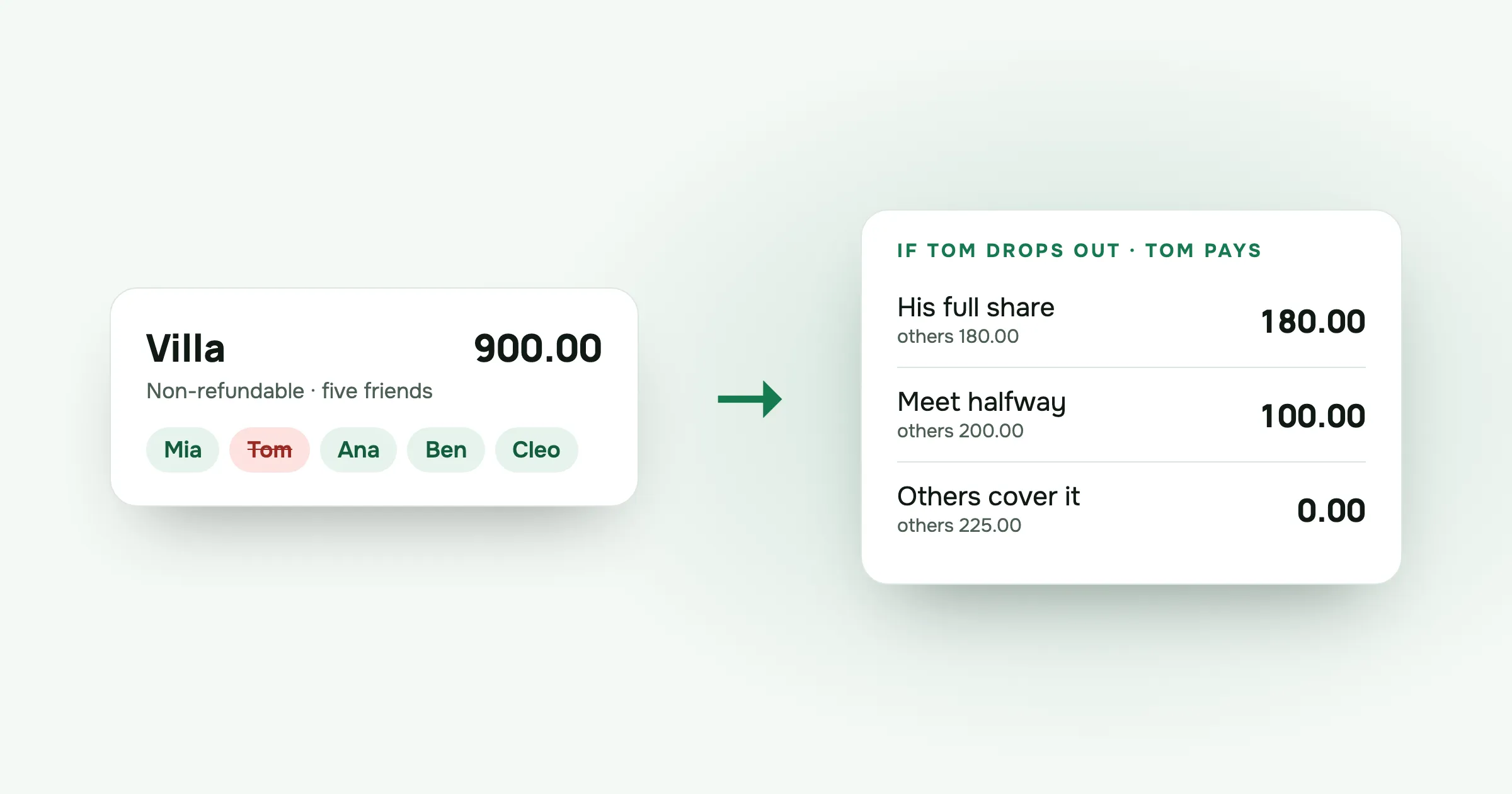
Six weeks before the trip, Tom posts the message nobody wants to read in the group chat. He can’t come. Mia booked the villa back in March: 900.00 for five people, non-refundable, all on her card. Ben bought the ferry tickets. Now there are four people, the same villa and one awkward question about who pays Tom’s part.
There’s no single right answer. There is a fair default, a few reasonable alternatives, and one rule that saves a lot of trouble if you agree it before booking.
First, check what can still be refunded
Before anyone argues about money, find out how much money is actually lost. Look at each booking:
- Fully refundable. Cancel Tom’s part and nobody is out of pocket.
- Partly refundable. Some places return part of the price up to a date, or charge a cancellation fee.
- Non-refundable. The cost is fixed whether four people turn up or five.
- Changeable. Some tickets can’t be refunded but the name on them can be changed, sometimes for a fee.
Spend ten minutes on this, because the answer decides how big the problem is.
Look for someone to take their place
The cleanest fix is a replacement. If a friend of the group can come instead, they pay Tom’s share, Tom pays nothing and the others pay what they planned.
Ask the person who left to help find someone, since they have the strongest reason to fill the place. If changing the name on a booking costs a fee, the person who left usually pays it. It’s smaller than the share they’d otherwise owe.
In split-cash, the replacement doesn’t need an account yet. Add them to the group by name, then edit the booking: untick Tom and tick the new person. Their balance shows what they owe Mia straight away, and Tom’s goes back to zero.
If nobody replaces them: three fair options
When the money is gone and nobody new is coming, the group has three options.
- The person who left pays their full share. The booking was made for five people, at their request. This is the fairest default, and the easiest to agree on before anyone is upset.
- The others split it. The four who still go cover the whole cost. This makes sense when someone drops out for a reason outside their control, like illness or a family emergency, and the group would rather absorb it than send a bill.
- Meet halfway. The person who left pays half their share, and the rest is spread across the others.
What matters is that the person who paid the booking isn’t left carrying the gap alone. Mia paid 900.00 on the understanding that four other people would pay her back. Whatever the group decides, she should end up whole.
What each option looks like in split-cash
Mia added the villa as one expense of 900.00, paid by her and split equally between all five of them. Each share is 180.00. Here’s how each choice looks, using only that expense.
Option 1: Tom pays his share. Leave the expense as it is.
| Mia | Tom | Ana | Ben | Cleo | |
|---|---|---|---|---|---|
| Share | 180.00 | 180.00 | 180.00 | 180.00 | 180.00 |
| Balance | +720.00 | −180.00 | −180.00 | −180.00 | −180.00 |
Mia paid 900.00 and her own share is 180.00, so she’s owed 720.00. The four others owe 180.00 each, which adds up to the same 720.00.
Option 2: the others split it. Edit the expense and untick Tom. split-cash divides the same 900.00 between four people, so each share becomes 225.00.
| Mia | Tom | Ana | Ben | Cleo | |
|---|---|---|---|---|---|
| Share | 225.00 | 0.00 | 225.00 | 225.00 | 225.00 |
| Balance | +675.00 | 0.00 | −225.00 | −225.00 | −225.00 |
Each of the four now pays 45.00 more, which is Tom’s 180.00 spread four ways. Mia is owed 675.00, and Ana, Ben and Cleo owe 225.00 each, which adds up to 675.00.
Option 3: meet halfway. Edit the expense, choose Shares, and give Tom 0.5 and everyone else 1. That’s 4.5 shares, so one share is 900.00 ÷ 4.5 = 200.00. Shares accept decimals, so 0.5 works.
| Mia | Tom | Ana | Ben | Cleo | |
|---|---|---|---|---|---|
| Share | 200.00 | 100.00 | 200.00 | 200.00 | 200.00 |
| Balance | +700.00 | −100.00 | −200.00 | −200.00 | −200.00 |
Check it: 100.00 + 4 × 200.00 = 900.00, and the balances add up to zero.
Editing the expense is all it takes, and everyone sees the new amounts in the group. If you want to try the numbers before you change anything, the trip expense splitter works without an account.
When part of a booking is refunded
Partial refunds need one more step. Say Ben paid 200.00 for five ferry tickets at 40.00 each. Tom’s ticket is cancelled with a 10.00 fee, and 30.00 comes back to Ben’s card.
The ferry now cost 170.00, so edit the expense to 170.00. Don’t just untick Tom, because then the four others would pay 42.50 each and Tom’s fee would land on them. Choose Amounts instead and enter 10.00 for Tom and 40.00 for each of the other four. Check it: 10.00 + 4 × 40.00 = 170.00.
The refund came from Tom’s cancelled place, so it reduces only Tom’s share. The same idea works for any booking that’s priced per person.
If they already paid you back
Sometimes the person who drops out has already paid. Say Tom sent Mia his 180.00 in April and the group then agrees on option 2.
The payment stays recorded in the group. Once Tom is unticked from the villa, his balance shows that he’s owed 180.00, and Settle up includes that money going back to him. Nobody has to remember who sent what in April.
Agree a cancellation rule before you book
Most arguments about dropouts happen because the rule is decided after someone has already dropped out. At that point everyone has a side.
Write one or two sentences in the group chat before the booking is paid, and ask everyone to reply that they agree. For example:
Once we book, your share is yours. If you can’t come, find someone to take your place or pay your share. If you’re ill or there’s an emergency, we split it between the rest.
Some groups add a cut-off date: drop out before it and the group covers you, after it and you pay. The exact rule matters less than agreeing it early.
It also helps to collect the money early. When everyone pays the booker as soon as the booking is made, nobody is tempted to quietly drop out with the booker’s money still outstanding. The booker can add How to pay me details so everyone knows where to send it, and Remind opens the phone’s share menu so a nudge takes a few seconds.
Questions people ask
Does a friend who cancels a trip still have to pay? If the booking was non-refundable and nobody takes their place, the fairest default is that they pay their share. The others didn’t choose to pay more. A group can agree something softer, but it should agree before anyone books.
What happens to the deposit when someone backs out of a trip? It stays part of the booking. If the deposit can’t be refunded, it’s split as before, and the person who left still pays their part unless someone replaces them or the group agrees otherwise.
Who gets the refund when someone drops out? The refund goes back to whoever paid the booking, and it should lower the share of the person who dropped out, because it was their place that was cancelled. Edit the expense to the amount actually charged and split it so they pay only what wasn’t refunded.
What if someone else takes their place? Then the new person pays the share and the person who left pays nothing. In split-cash, edit the booking, untick the person who left and tick the new person instead.
Planning a trip with friends? Make a group in split-cash, add the booking and agree your rule in the chat. It’s free, with no ads.
 Sabir Shaykhlislamov Built split-cash