How to split a taxi fare with multiple stops fairly
Three friends share one taxi from the airport and get out at different distances. Three fair ways to split the fare, with a worked example by distance.
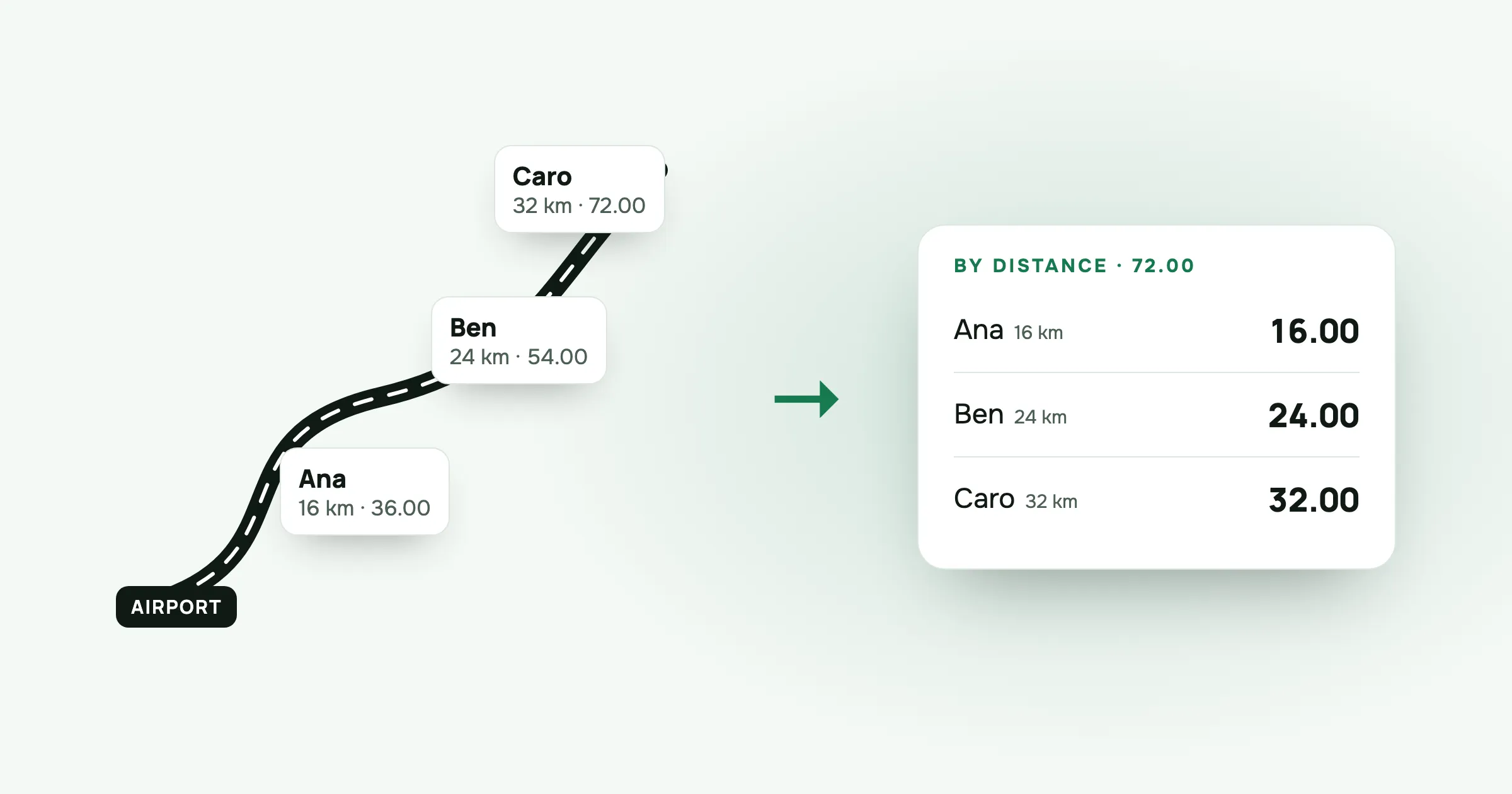
The flight lands at 11:40 at night and the last train has gone. Ana, Ben and Caro share a taxi from the airport. Ana lives closest, Ben a bit further out and Caro furthest. The driver drops them one by one, and when Caro gets out alone at the end, the meter says 72.00. She pays by card.
The next morning, in the group chat, someone says “24 each?” and Ana, who got out first, isn’t sure that’s right. She’s probably correct, but the fix depends on which kind of fair the three of them mean.
Note the meter at each stop
Before the methods, one habit makes all of them easier. When someone gets out, glance at the meter and note the amount. For the ride above:
- Ana gets out at 16 km. The meter shows 36.00.
- Ben gets out at 24 km. The meter shows 54.00.
- Caro gets out at 32 km. The meter shows 72.00.
That’s all the information any of the methods need. If you forget, the distances from a map are close enough.
Method 1: split equally
Divide the fare by the number of people. 72.00 ÷ 3 = 24.00 each.
This is quick and fine when the stops are close together, or when the same group shares taxis often and the order changes each time. It’s unfair when one person gets out early and another rides twice as far. Here, Ana pays 24.00 for 16 km, and Caro pays the same for 32 km.
Method 2: split by distance
Each person pays in proportion to how far they rode. It works the same way as counting person-nights for a holiday rental.
- Add up everyone’s kilometres. Ana 16 + Ben 24 + Caro 32 = 72 km.
- Work out the rate. 72.00 ÷ 72 km = 1.00 per km.
- Multiply. Ana pays 16.00, Ben pays 24.00 and Caro pays 32.00.
Check it: 16.00 + 24.00 + 32.00 = 72.00.
This is easy to explain and easy to agree on. Everyone pays the same rate for every kilometre they were in the car. The person who rode twice as far pays twice as much.
Method 3: shared part equal, extra legs to whoever caused them
This method splits the ride into legs and asks who needed each one.
- Airport to Ana’s stop: 36.00. All three of them needed this part, so they split it equally: 12.00 each.
- Ana’s stop to Ben’s: 54.00 − 36.00 = 18.00. Ana was already home. Ben and Caro both needed this leg, so they split it: 9.00 each.
- Ben’s stop to Caro’s: 72.00 − 54.00 = 18.00. Only Caro needed it, so she pays it all.
Ana pays 12.00. Ben pays 12.00 + 9.00 = 21.00. Caro pays 12.00 + 9.00 + 18.00 = 39.00.
Check it: 12.00 + 21.00 + 39.00 = 72.00.
This one follows the meter most closely. It also reflects something method 2 misses: when Caro rides the last 8 km alone, the whole cost of those kilometres is hers.
Comparing the three
| Ana | Ben | Caro | |
|---|---|---|---|
| Distance | 16 km | 24 km | 32 km |
| Equal | 24.00 | 24.00 | 24.00 |
| By distance | 16.00 | 24.00 | 32.00 |
| Shared part equal, extra legs | 12.00 | 21.00 | 39.00 |
Each row adds up to 72.00. Every method saves all three money compared with taking a taxi alone, which is why sharing was a good idea in the first place.
Which one to pick:
- Stops within a few minutes of each other: split equally.
- Stops at clearly different distances along one route: split by distance. It’s the easiest uneven method to agree on.
- One person goes much further than the others: shared part equal, extra legs to whoever caused them.
The only wrong choice is deciding after the ride, when everyone already knows which method suits them. Agree it while you’re waiting in the taxi queue.
Detours, tolls and the tip
Detours. If a stop is off the main route, the extra driving is caused by one person. Ask the driver or check the map for the extra distance, and add that part to that person’s amount before splitting the rest.
Airport fees and tolls. A fixed airport pickup fee, or a toll on the motorway everyone used, belongs in the shared part. With method 3 it’s already there, because it’s included in the meter reading at the first stop. With method 2, take it out first, split it equally, and split the rest by distance.
The tip. Add the tip to the fare and split the total with the same method. A 10% tip on a 72.00 fare makes 79.20, and by distance that’s 17.60, 26.40 and 35.20.
Check it: 17.60 + 26.40 + 35.20 = 79.20.
Uber and other apps
If you booked through Uber or another app, there may be no meter to read at each stop. Take the distance from the pickup to each person’s stop from a map and split by distance. It’s the method that needs the least information.
Pickups work the same way in reverse. If the taxi collects three people on the way to the airport, the first person picked up rides the furthest.
Recording it in split-cash
If the taxi is part of a trip, add it to the trip’s group like any other expense, paid by whoever paid the driver.
- Equal: leave it split equally between the three.
- By distance: choose Shares and type each person’s kilometres as their shares: 16, 24 and 32. split-cash works out 16.00, 24.00 and 32.00. Shares accept decimals, so 12.5 km works too.
- Shared part equal, extra legs: choose Amounts and type 12.00, 21.00 and 39.00. split-cash shows what’s left to assign until the amounts add up to the fare.
Balances follow from there. With the by-distance split and Caro paying, Caro is owed 72.00 − 32.00 = 40.00, Ana owes 16.00 and Ben owes 24.00. That adds up to zero, and Settle up shows the two transfers to Caro. Attach a photo of the receipt if the driver gave one.
Driving to the airport in one car instead? The fuel cost calculator works out fuel and parking per person without an account.
Questions people ask
How do you split a taxi with multiple stops? Split it equally, split it by how far each person rode, or split the stretch everyone shared equally and give each extra leg to the people who needed it. Agree which one before you get in.
How do you split an Uber fare fairly when people get out at different places? The same way as a taxi. Take the distance from the pickup to each person’s stop from the map, and split the fare in proportion to those distances.
Who should pay more on an airport taxi with several stops? The person dropped off last, because they ride furthest and usually ride the last stretch alone. When the stops are close together, an equal split is fine and much quicker.
Should the tip be split the same way as the fare? Yes. Add the tip to the fare and split the total with the same method, so each person’s part of the tip matches their part of the ride.
Sharing a ride from the airport? Make a group in split-cash and add the fare before everyone goes to bed. It’s free, with no ads.
 Sabir Shaykhlislamov Built split-cash