How to split Friendsgiving and Thanksgiving dinner costs fairly
Split Friendsgiving or Thanksgiving dinner fairly: the host's turkey and drinks, potluck dishes, the guest with pricey wine, and paying the host back.
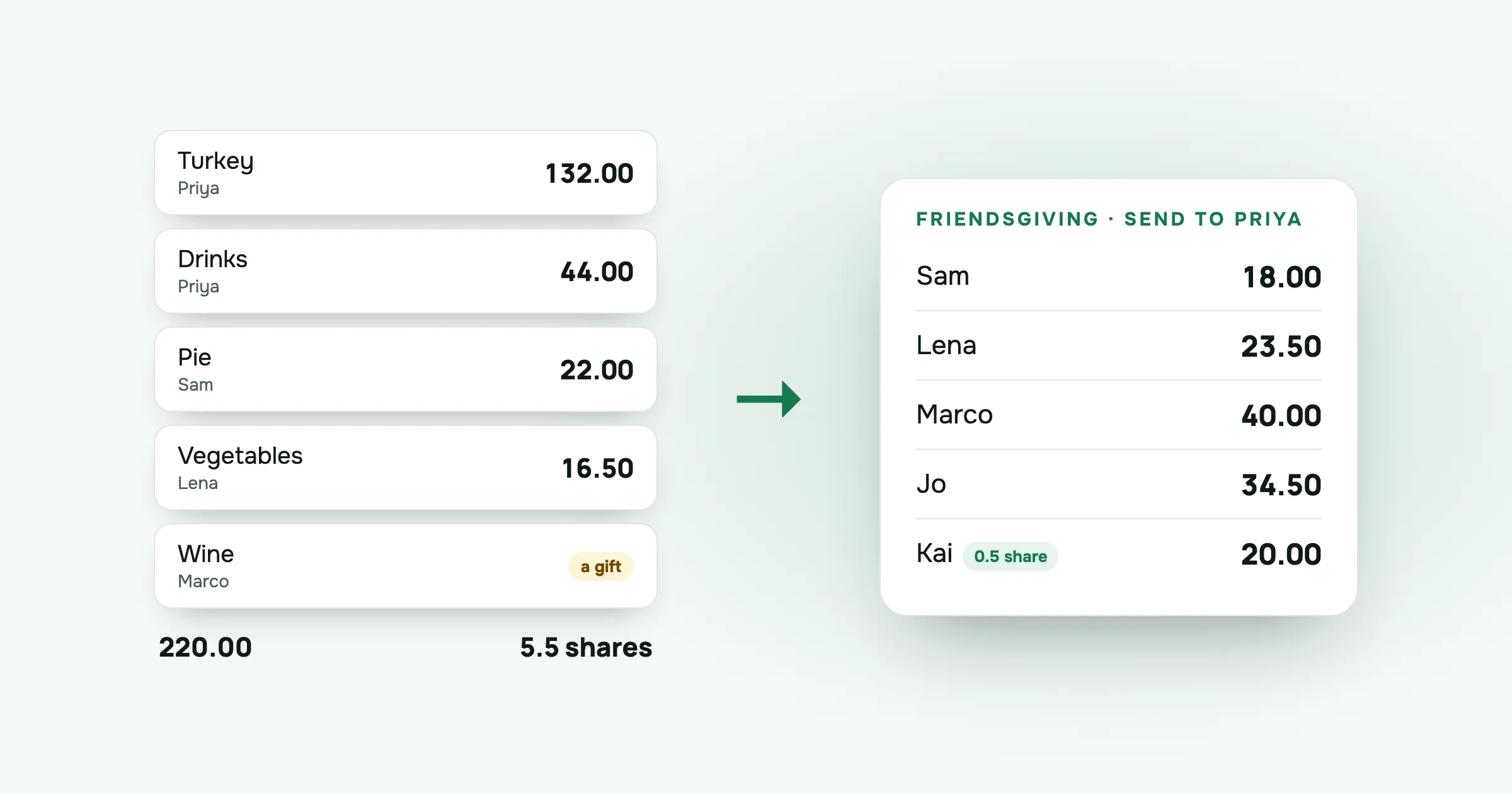
Priya offered to host Friendsgiving and meant it. Then the turkey cost more than she expected, the drinks came to another bag and a half, and on Thursday evening she had a kitchen full of food she’d paid for and five friends arriving with a pie, a tray of vegetables, some bread rolls and one very nice bottle of wine.
Nobody wants to hand the host an invoice over dessert. But nobody wants the host to quietly pay for everyone either. A fair split is simple if you agree the method before the shopping starts.
Potluck or split the bill?
There are three common ways to run it. Pick one and say it in the group chat before anyone shops.
- Pure potluck. Everyone brings something, the host does the turkey, and nobody counts money. This works when the dishes cost roughly the same, or when the host is happy to treat everyone.
- Split the host’s costs. Guests bring dishes as their contribution, and the host’s shopping is split between everyone, host included. Easy, but the person who brought bread rolls pays the same as the person who brought a pie.
- Count everything. Everyone keeps their receipt, all the shopping is added up and divided, and the people who spent less pay the people who spent more. This is the fairest when the costs are uneven, which they usually are.
The turkey is what tips it. It’s often the single biggest cost of the evening, and it almost always lands on the host. A pure potluck leaves the host paying several times what anyone else did.
What goes in the host’s pile
The host’s costs are anything bought for everyone:
- the turkey and stuffing
- sides and sauces the host makes
- drinks bought for the table, alcoholic or not
- ice, napkins, foil, extra chairs or plates bought for the evening
Leave out things the host would have bought anyway, like salt or washing-up liquid. If the host has to buy a roasting tin, that’s a judgement call. Most groups don’t charge for it, because the host keeps the tin.
Dishes guests bring
If you’re counting everything, each guest’s dish is an expense too. Sam bought a pie and cream, so Sam adds what he spent. Lena roasted vegetables, so she adds her receipt.
This is fairer than the potluck version, because a guest who spends 22.00 on a pie and a guest who spends 5.50 on bread rolls don’t end up in the same place. It only works if people actually keep their receipts, so mention it when you hand out the dishes.
The guest with the expensive bottle
Every Friendsgiving has one. Marco shows up with a 45.00 bottle of wine.
If nobody asked for it, it’s a gift. Thank Marco, open it, and don’t add it to the shared costs. Counting it would mean five other people paying for a bottle they didn’t choose.
If the host asked Marco to bring the wine, count it, but count it at what an ordinary bottle costs, say 11.00. The rest is Marco’s treat. Agree this on the day so Marco doesn’t feel cheated and nobody feels billed for a bottle they’d never have bought.
Someone only comes for dessert
Kai has dinner with his family and comes over for pie. Charging him a full share of the turkey he didn’t eat isn’t fair, and leaving him out entirely isn’t either.
Split by shares. Everyone who came for the whole dinner gets 1 share. Kai gets 0.5. The same works for a small child, or a friend who leaves before the main course.
A worked example
Six friends: Priya (host), Sam, Lena, Marco, Jo and Kai. They agreed to count everything. Marco’s 45.00 bottle was a gift and isn’t counted.
| Expense | Paid by | Amount |
|---|---|---|
| Turkey and trimmings | Priya | 132.00 |
| Drinks | Priya | 44.00 |
| Pumpkin pie and cream | Sam | 22.00 |
| Roast vegetables | Lena | 16.50 |
| Bread rolls and cranberry sauce | Jo | 5.50 |
| Total | 220.00 |
Each expense is split by Shares: Priya, Sam, Lena, Marco and Jo get 1 each, and Kai gets 0.5. That’s 5.5 shares, so one share is 220.00 ÷ 5.5 = 40.00. Kai’s half share is 20.00.
Check it: 5 × 40.00 + 20.00 = 220.00.
Now compare what each person paid with what they owe:
| Paid | Share | Balance | |
|---|---|---|---|
| Priya | 176.00 | 40.00 | +136.00 |
| Sam | 22.00 | 40.00 | −18.00 |
| Lena | 16.50 | 40.00 | −23.50 |
| Marco | 0.00 | 40.00 | −40.00 |
| Jo | 5.50 | 40.00 | −34.50 |
| Kai | 0.00 | 20.00 | −20.00 |
The balances add up to zero: 18.00 + 23.50 + 40.00 + 34.50 + 20.00 = 136.00, exactly what Priya is owed.
If the host had asked Marco to bring wine and the group counted it at 11.00, the total would be 231.00, one share would be 42.00, and Marco would owe 31.00 instead of 40.00.
Paying the host back
The host is the only person owed money here, so Settle up shows five transfers, all to Priya: Sam 18.00, Lena 23.50, Marco 40.00, Jo 34.50 and Kai 20.00.
A few things make the collecting painless:
- Add the expenses that night. Each person adds their own receipt from their phone, and attaches a photo of it if they like. Friends who haven’t signed up can be added to the group by name first, and join later with the invite link.
- Put your payment details in. Priya adds How to pay me details, so everyone can see where to send the money.
- Mark as paid when it arrives. When Lena sends her 23.50, Priya taps Mark as paid. If someone sends part now and part later, partial payments work too.
- Remind the slow ones. Remind opens the phone’s share menu, so a nudge takes a few seconds and doesn’t have to come up at the next dinner.
If everyone counts as one full share and you’d rather not make a group for one evening, the who owes who calculator does the sum without an account. Type what each person spent and it lists the transfers.
Questions people ask
Should Friendsgiving guests pay the host back? If the host bought the turkey and drinks for everyone, yes, guests should offer to cover their part. Add up what everyone spent, dishes included, split the total and have each guest pay the host the difference.
Is a potluck fairer than splitting the bill? A potluck is simpler and works when the dishes cost about the same. When the host spends far more than anyone else, which is usual because of the turkey, counting everyone’s receipts and splitting the total is fairer.
What if a guest brings an expensive bottle of wine? Treat it as a gift unless the host asked for it. If the group agrees to count it, count what an ordinary bottle costs, so nobody pays for someone else’s taste.
How do you split Thanksgiving dinner with someone who only comes for dessert? Give them a smaller part. Split by shares, with 1 for each guest who came for the whole dinner and 0.5 for someone who only came for dessert.
Hosting this year? Make a group in split-cash and send the link with the dish list. It’s free, with no ads.
 Sabir Shaykhlislamov Built split-cash