How to split expenses with friends: equal, by shares, percent or exact amounts
The four ways to split costs with friends, when each one is fair, how to leave out people who weren't there, and how to settle up at the end.
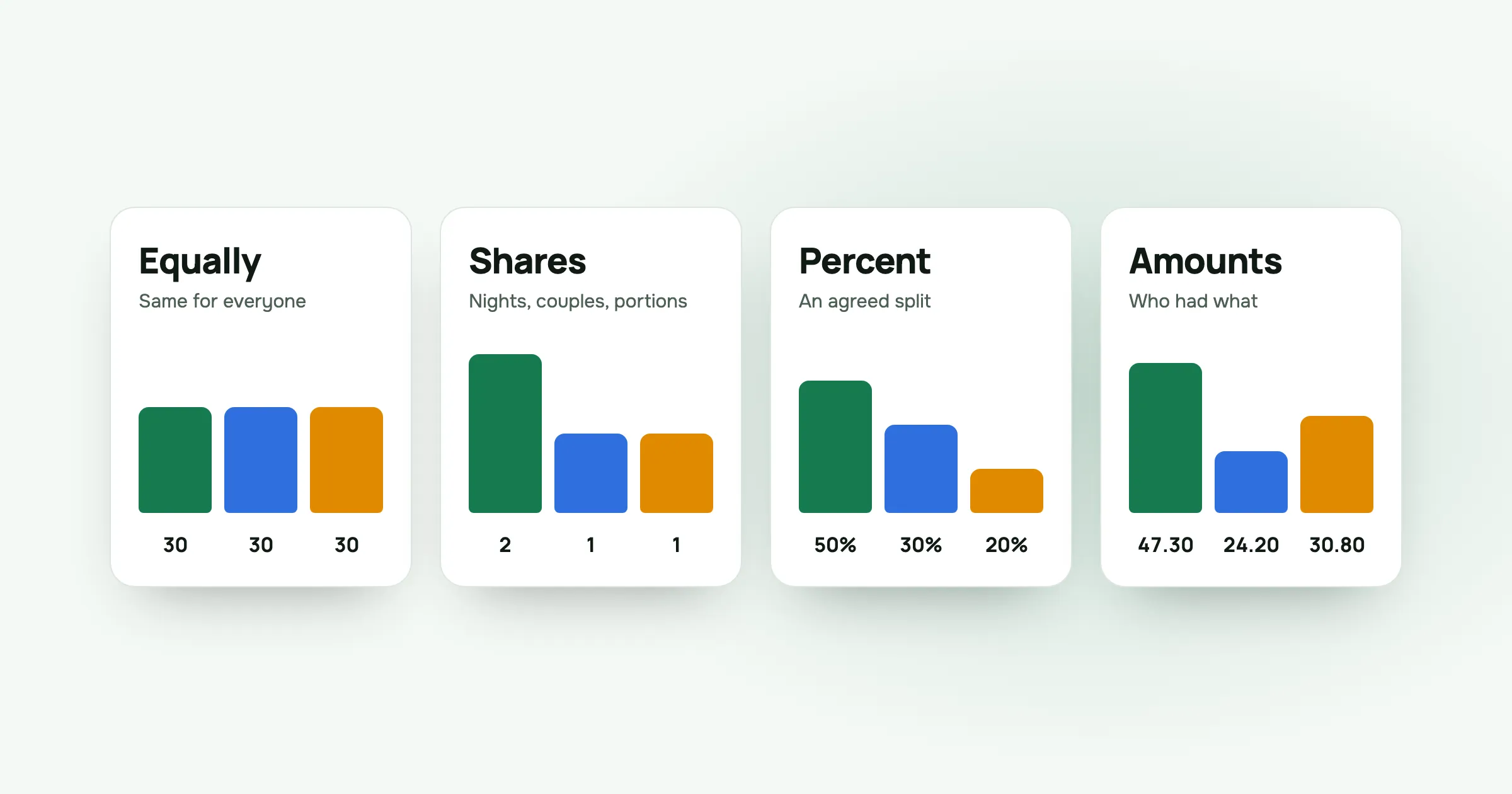
Splitting costs with friends goes wrong in two ways. Either nobody keeps track, and someone ends up quietly out of pocket, or someone keeps track so precisely that splitting a pizza needs a calculator.
The fix is knowing which way of splitting fits which cost. There are only four, and most costs need the first one.
1. Equally
Divide the cost by the number of people who shared it. A 90.00 taxi for three people is 30.00 each.
Use it for accommodation where everyone stays the same nights, group dinners where people ordered roughly the same, fuel, groceries and tickets.
Equal is fair more often than people think. Over a weekend, the person who had the cheaper lunch has the more expensive dinner. When a group needs something more precise, it’s usually because one cost was clearly lopsided.
Leaving people out
Before reaching for anything more complicated, check who was actually there. Most “unfair” splits are costs that included someone who didn’t take part.
- Someone skipped the boat trip: leave them out of it.
- Someone doesn’t drink: put the drinks in a separate expense without them.
- Someone arrived a day late: leave them out of the first night’s dinner.
In split-cash, every expense has its own list of people. Untick whoever wasn’t part of it, and the cost is split equally between the rest.
2. By shares
Give each person a number of shares, and the cost is divided in proportion. Two shares pay twice as much as one.
Use it for things that are easy to count:
- Nights. Someone who stayed two nights out of four gets 2 shares and the others get 4. More in how to split an Airbnb with friends.
- Couples. A couple paying as two gets 2 shares on one expense.
- Bigger portions. Someone who had twice as much gets 2 shares.
- The driver. A driver who brings their own car gets half a share of the fuel. More in how to split gas on a road trip.
Shares are the most useful option that most people never use. There’s no maths, and decimals work, so 1.5 or 0.75 is fine.
3. By percent
Give each person a percentage. The percentages have to add up to 100.
Use it when the group has already agreed percentages for a reason. For example, two families share a holiday house 60/40 because one family is bigger, or friends agree that whoever earns more pays more. Percent only works when everyone agrees to it openly.
4. By exact amounts
Type what each person owes. The amounts have to add up to the total.
Use it for receipts where each person’s part is clear: a restaurant bill where everyone ordered different things, or a shared online order. More in how to split a restaurant bill.
Agree the rule before the cost
Most arguments about shared money start with a method someone chose after the fact. A few things to say out loud at the start of a trip:
- What’s shared: accommodation, transport, group meals. What isn’t: souvenirs, the extra cocktail.
- How uneven costs work: “you only pay for what you took part in”.
- When you’ll settle: the last evening, or the day after.
How to split trip costs with friends goes through this in more detail.
Keep track as you go
Whatever method you pick, the costs that cause trouble are the ones nobody recorded. The habit that fixes it: whoever pays adds the cost straight away, from their own phone.
In split-cash, one person makes a group and sends the invite link to the group chat. Everyone adds what they pay, picks who shares it and how, and sees their balance update. Friends who haven’t joined yet can be added by name. If you’d rather use a spreadsheet, here’s a simple setup.
Settle up at the end
At the end, don’t pay back each cost separately. Add up what each person paid and owes, and settle the differences. A group of five never needs more than four transfers. How to settle group debts with the fewest payments shows the method with a worked example, and split-cash does it for you on the Settle up screen.
If someone forgets to pay, here’s how to ask without it getting awkward.
Questions people ask
What is the fairest way to split expenses with friends? Split equally when everyone used roughly the same. Leave people out of costs they had nothing to do with. Use shares or exact amounts when someone clearly had more or less. Agree the rule before the costs happen.
When should you split by shares instead of equally? When people used something in different amounts that are easy to count, like nights in a rental, people in a couple, or one person having twice as much. Give each person a number of shares and the cost is divided in proportion.
How do you split costs when incomes are different? Some groups split by percent so that people who earn more pay a larger part. It only works if everyone agrees to it openly. For trips with friends, most groups split by what people used and let each person choose what to join.
What’s the easiest way to keep track of shared expenses? Record each cost when it’s paid, from the phone of whoever paid, in a shared app. Then everyone can see their balance and settle up at the end in a few transfers.
Sharing costs with friends soon? Make a group in split-cash and send the link. It’s free, with no ads.
 Sabir Shaykhlislamov Built split-cash