How to settle group debts with the fewest payments
How netting balances turns fifteen transfers into three, with a worked example you can check with a calculator.
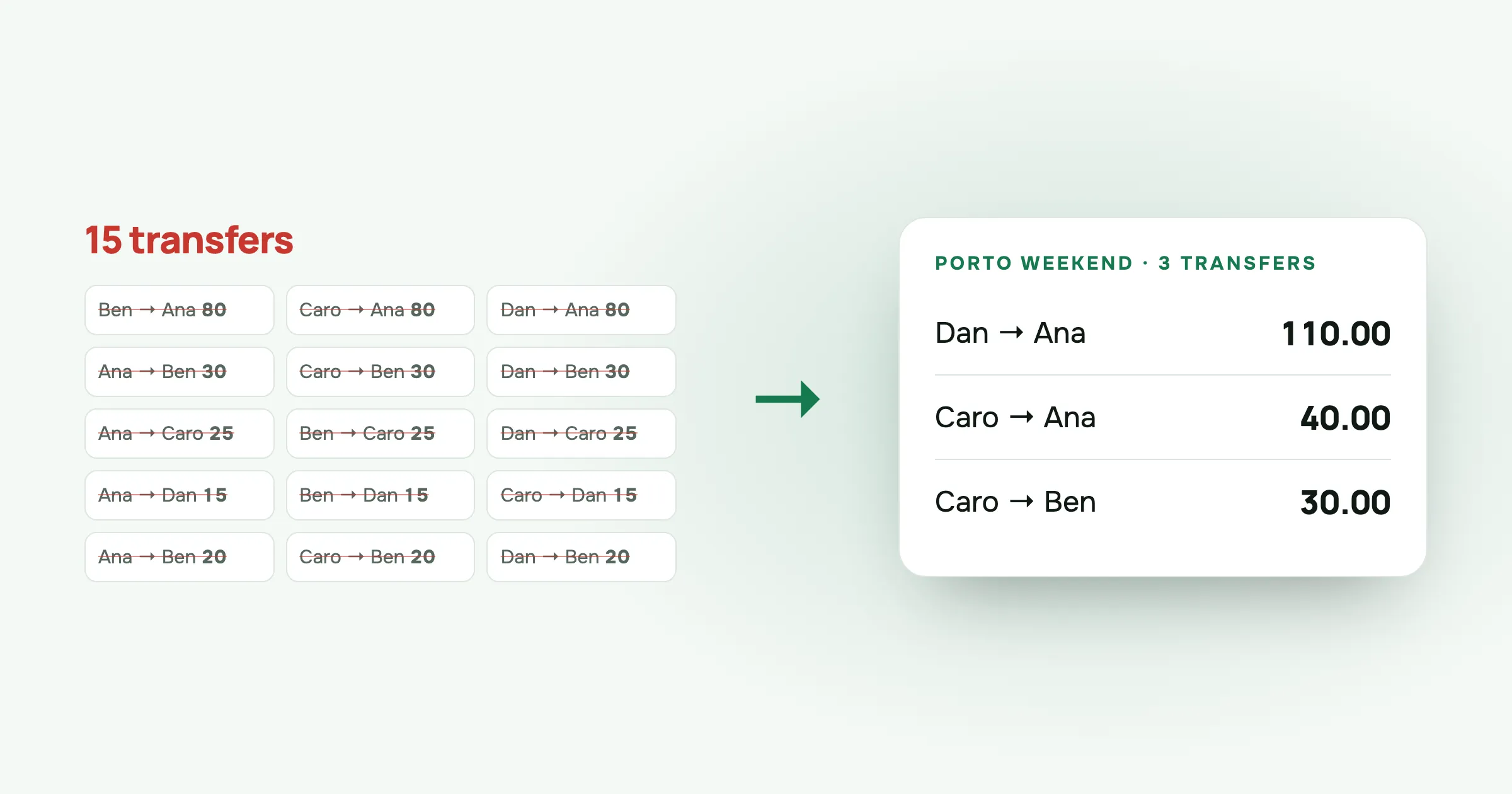
After a weekend away with friends, you might have twenty expenses in the group. If everyone paid back each expense separately, you’d be looking at dozens of small transfers, half of them going in opposite directions between the same two people.
There’s a shorter way, and it’s how split-cash settles every group.
Settle balances, not expenses
Each person in a group has one number that matters at the end: everything they paid, minus their share of everything. That’s their balance.
- A positive balance means the group owes them money.
- A negative balance means they owe the group.
- The balances always add up to zero, because every euro someone paid was someone’s share.
Once you have those numbers, the individual expenses stop mattering. You only need transfers that bring every balance to zero.
A worked example
Four friends spend a weekend in Porto. Everything is split equally.
| Expense | Paid by | Amount |
|---|---|---|
| Flat, two nights | Ana | 320.00 |
| Train tickets | Ben | 120.00 |
| Dinner on Friday | Caro | 100.00 |
| Port tasting | Dan | 60.00 |
| Dinner on Saturday | Ben | 80.00 |
The total is 680.00, so each person’s share is 170.00. Now the balances:
- Ana paid 320.00, share 170.00, balance +150.00
- Ben paid 200.00, share 170.00, balance +30.00
- Caro paid 100.00, share 170.00, balance −70.00
- Dan paid 60.00, share 170.00, balance −110.00
Paying back each expense separately means three people paying Ana for the flat, three paying Ben for the train, three paying Caro for Friday, three paying Dan for the tasting and three paying Ben again for Saturday. That’s fifteen transfers.
Settling the balances takes three:
- Dan sends Ana 110.00.
- Caro sends Ana 40.00.
- Caro sends Ben 30.00.
Check it: Ana receives 150.00, Ben receives 30.00, Caro pays 70.00 and Dan pays 110.00. Every balance is zero.
How the plan is worked out
The method is simple enough to do by hand on a napkin:
- Take the person who owes the most and the person who is owed the most.
- The one who owes pays the smaller of the two amounts.
- One of them is now at zero. Repeat with whoever is left.
Each step settles at least one person, so a group of five never needs more than four transfers, and a group of ten never needs more than nine. Often it’s fewer, because some people are already even.
split-cash does this for you on the Settle up screen. It lists your own payments first, so you see straight away what you have to send and what’s coming to you.
“But I never owed Ana anything”
This is the objection people raise most. In the example, Caro paid for Friday’s dinner and had nothing to do with the flat booking, yet she ends up sending money to Ana.
Caro owes the group 70.00 either way. Sending it to Ana, to Ben or to both doesn’t change what she pays. It only changes how many transfers everyone has to make. If two people would rather settle directly, they can, and record it as a payment. The plan updates to match.
Settling in real life
The plan is the easy part. Groups stall at getting everyone to send the money. A few things help.
Settle while you’re still together. The last evening of a trip works well. Everyone has their phone out and remembers the costs.
Make paying you easy. In split-cash you can write how people should pay you, like an IBAN, a PayPal link or a phone number, under How to pay me in your account. People who owe you see it next to the transfer, with a button to copy it.
Mark each transfer as paid. When the money arrives, tap Mark as paid. The row stays on the plan with a tick, so whoever is helping the group settle can see what’s done. If someone sends only part, record that part and the rest stays open.
Send a nudge if you need to. Next to a transfer that’s coming to you, Remind opens your phone’s share menu with a short message: the amount, your payment details and a link to the group.
When the last transfer is ticked, the group shows everyone as settled. If it was a one-off trip, you can archive the group so it stops cluttering your list. It comes back by itself if anyone adds another cost.
Questions people ask
What does “simplify debts” mean? It means adding up everything each person paid and everything they owe, then settling the difference instead of each expense. Everyone ends up paying or receiving the same total, in fewer transfers.
How many payments does a group need to settle up? At most one fewer than the number of people in the group. Five friends never need more than four transfers, however many expenses they added.
Is it fair if I end up paying someone I never owed directly? Yes. The amount you pay is the same as before. Only the person you send it to changes, and everyone’s balance still reaches zero.
What if someone only pays back part of what they owe? Record the part they paid. Their balance goes down by that amount and the rest stays on the plan until it’s paid.
Have a group with a pile of costs to sort out? Start one in split-cash, add the expenses and open Settle up. It’s free, with no ads.
 Sabir Shaykhlislamov Built split-cash