How to split costs on a group holiday with couples and singles
Should a couple pay double? Three fair ways to split a holiday rental between couples and singles, compared side by side with real numbers.
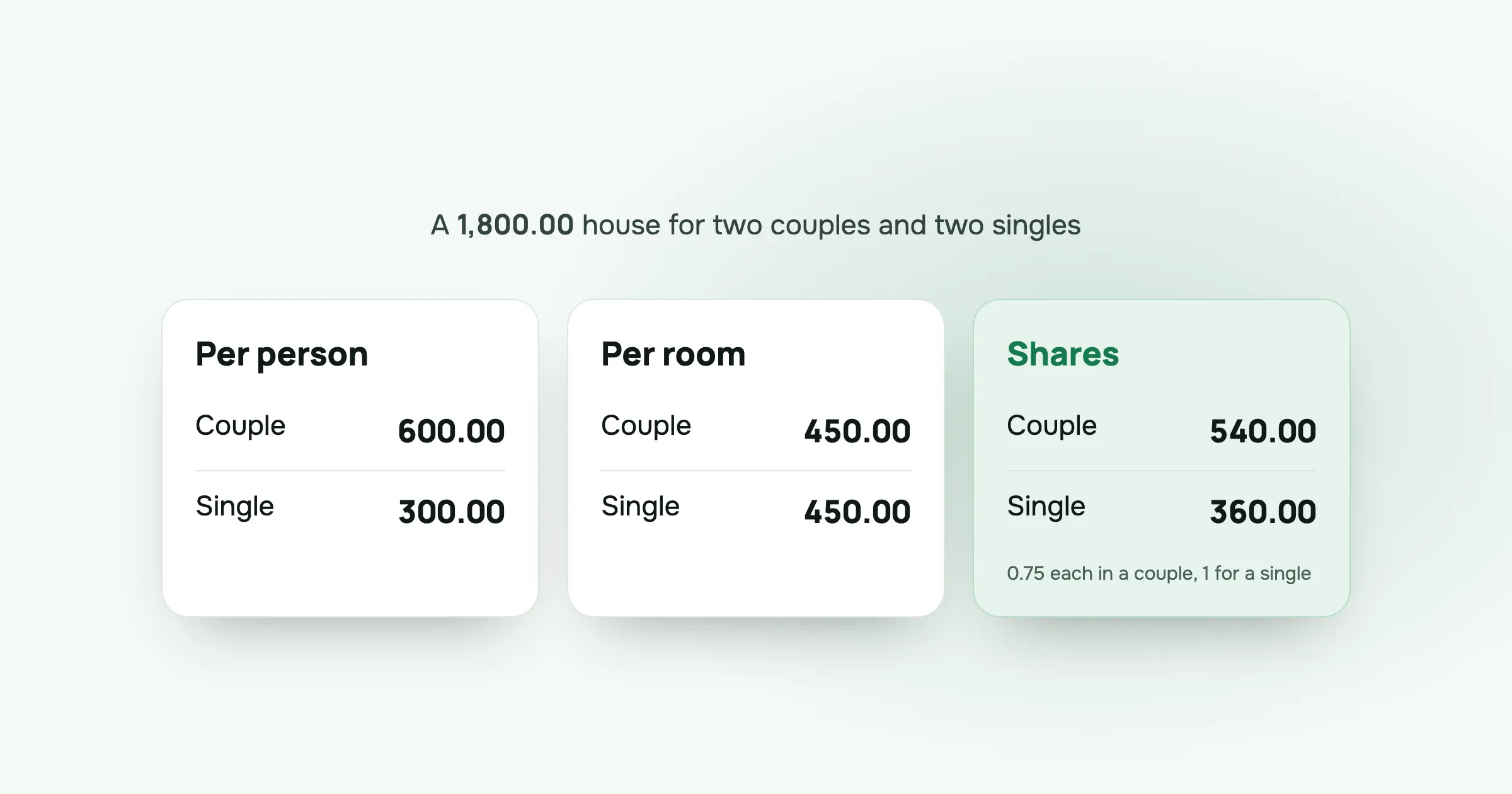
Six friends book a house for a week. Ana and Ben are a couple, and so are Cleo and Dev. Eli and Fay are coming on their own. The house has four bedrooms, so each couple shares a double and each single gets a room to themselves.
Fay books it and puts 1,800.00 on her card. Then someone asks the question every mixed group gets to sooner or later: is that 300.00 each, or 450.00 a room?
Both answers sound fair to the person giving them. This post is about choosing the rule. If you need the maths for rooms of different prices or people staying different nights, see how to split hotel rooms with friends and how to split an Airbnb with friends.
The three rules
There are only three common ways to split the rental between couples and singles.
Per person. Divide the total by the number of people. A couple pays twice what a single pays. The argument for it: two people are using the kitchen, the hot water and the pool, and everyone gets the same holiday.
Per room. Divide the total by the number of bedrooms. A couple pays the same as a single, so each person in a couple pays half what a single pays. The argument for it: a single gets a whole room, and a couple squeezes into one bed.
Somewhere in between. A couple pays more than one single but less than two. A common version is 1.5 times what a single pays. It accepts both arguments and usually ends the discussion.
None of these is wrong. What makes a split unfair is changing the rule after the booking, or never saying it out loud and letting each person assume their own.
The same house, three ways
Here’s Fay’s 1,800.00 house under each rule.
| Per person | Per room | Shares, couple 1.5 | |
|---|---|---|---|
| Each couple pays | 600.00 | 450.00 | 540.00 |
| Each person in a couple | 300.00 | 225.00 | 270.00 |
| Each single pays | 300.00 | 450.00 | 360.00 |
| Check: total | 2 × 600.00 + 2 × 300.00 = 1,800.00 | 4 × 450.00 = 1,800.00 | 2 × 540.00 + 2 × 360.00 = 1,800.00 |
The gap is wide. Under per person, a single pays 300.00. Under per room, the same single pays 450.00. The middle rule lands at 360.00, and each couple saves 60.00 compared with paying per person.
How the shares version works
Shares let you say “a couple counts as one and a half” without anyone reaching for a calculator.
- Give out the shares. Each single gets 1. Each person in a couple gets 0.75, so a couple together has 1.5.
- Add them up. Ana 0.75, Ben 0.75, Cleo 0.75, Dev 0.75, Eli 1, Fay 1. That’s 5 shares.
- Divide. 1,800.00 ÷ 5 = 360.00 per share.
- Multiply. Each person in a couple pays 0.75 × 360.00 = 270.00. Each single pays 360.00.
In split-cash you add the rental as one expense paid by Fay, choose Shares, and type 0.75 or 1 next to each name. Shares accept decimals, so the app does steps 2 to 4.
If you’d like a couple to count as 1.25 or 1.75 instead, change the numbers. Each person in the couple gets half of the couple’s figure.
Food and everything else: per person
The rental is where the argument happens. For almost everything else, per person is the obvious answer, and couples rarely object.
- Groceries, restaurant meals and drinks: two people eat and drink twice as much.
- Activity tickets, boat trips and museum entries: they’re priced per person anyway.
- Petrol and car hire: split between the people in that car.
So a holiday usually ends up with one weighted expense, the rental, and everything else split equally between whoever took part. If someone skips a dinner, untick them on that expense.
A worked example
Here’s the whole week for the six friends. They agreed the middle rule for the house, and equal splits for everything else.
| Expense | Paid by | Split | Each |
|---|---|---|---|
| House, 7 nights: 1,800.00 | Fay | Shares: couples 0.75 each, singles 1 | 270.00 or 360.00 |
| Groceries: 420.00 | Ana | Equally, all six | 70.00 |
| Dinner out: 360.00 | Dev | Equally, all six | 60.00 |
Each person’s share:
- Ana, Ben, Cleo and Dev: 270.00 + 70.00 + 60.00 = 400.00 each.
- Eli and Fay: 360.00 + 70.00 + 60.00 = 490.00 each.
Check it: 4 × 400.00 + 2 × 490.00 = 2,580.00, and 1,800.00 + 420.00 + 360.00 = 2,580.00.
Balances, which is what each person paid minus their share:
- Fay: 1,800.00 − 490.00 = +1,310.00
- Ana: 420.00 − 400.00 = +20.00
- Dev: 360.00 − 400.00 = −40.00
- Ben: −400.00
- Cleo: −400.00
- Eli: −490.00
They add up to zero: 1,310.00 + 20.00 = 1,330.00 owed, and 40.00 + 400.00 + 400.00 + 490.00 = 1,330.00 to pay. Settle up turns that into the fewest transfers, and each person sees who to pay and how much.
Couples who share money
Many couples pay for things from one account and don’t care which of them owes what. You have two practical options:
- Add both people. Each gets their own shares and balance. Couples settle between themselves however they like, and the group still sees who was there.
- Add one person for the couple. Untick the partner, or leave them out of the group, and give the one person the couple’s shares: 1.5 on the house and 2 on groceries and dinners.
The first is clearer for the group. The second gives the couple one balance and one transfer. Pick one and use it for the whole trip, or the numbers get confusing.
How to agree it without an argument
- Raise it before booking. “Are we splitting the house per person or per room?” is an easy question when nobody has paid. After the deposit, it sounds like a request for a discount.
- Let the people it costs more propose it. If a single suggests the couples pay a bit more, or a couple offers it, it lands well. A rule imposed by the side that benefits doesn’t.
- Look at the rooms. If the singles are on sofa beds or sharing a twin room, per person is fair. If each single has a bigger room than the couples, the case for weighting gets stronger.
- Make it visible. Once the rental is entered with its shares, everyone in the group can see the rule and the numbers.
If the real question is that some of the group have tighter budgets, see how to split costs with friends who earn different amounts.
Questions people ask
Should a couple pay double on a group holiday? For food, drinks and activities, yes, because two people eat and drink. For the rental, it depends on the rule the group picks. Per person means a couple pays double, per room means they pay the same as a single, and many groups settle in between.
Is it fairer to split a vacation rental per person or per couple? Per person is simplest and works when everyone has a similar room. Per room suits groups where singles get a whole bedroom each. A middle rule, where a couple pays 1.5 times what a single pays, is often the one both sides accept.
How do you split costs between couples and singles in an app? In split-cash, choose Shares on the rental and give each person in a couple 0.75 and each single 1. Shares take decimals, so the app does the division. Split food and other costs equally between everyone who was there.
When should the group decide how to split? Before anyone books. Once the deposit is paid, changing the rule feels like someone is asking for a discount. Agree it in the group chat while you’re still choosing the house.
Mixed group going away together? Make a group in split-cash, add the house with the shares you agreed and send the link. It’s free, with no ads.
 Sabir Shaykhlislamov Built split-cash