How to split costs with friends who earn different amounts
Ways to share trip costs when friends have very different budgets, from optional extras to an agreed percent split, and how to raise it kindly.
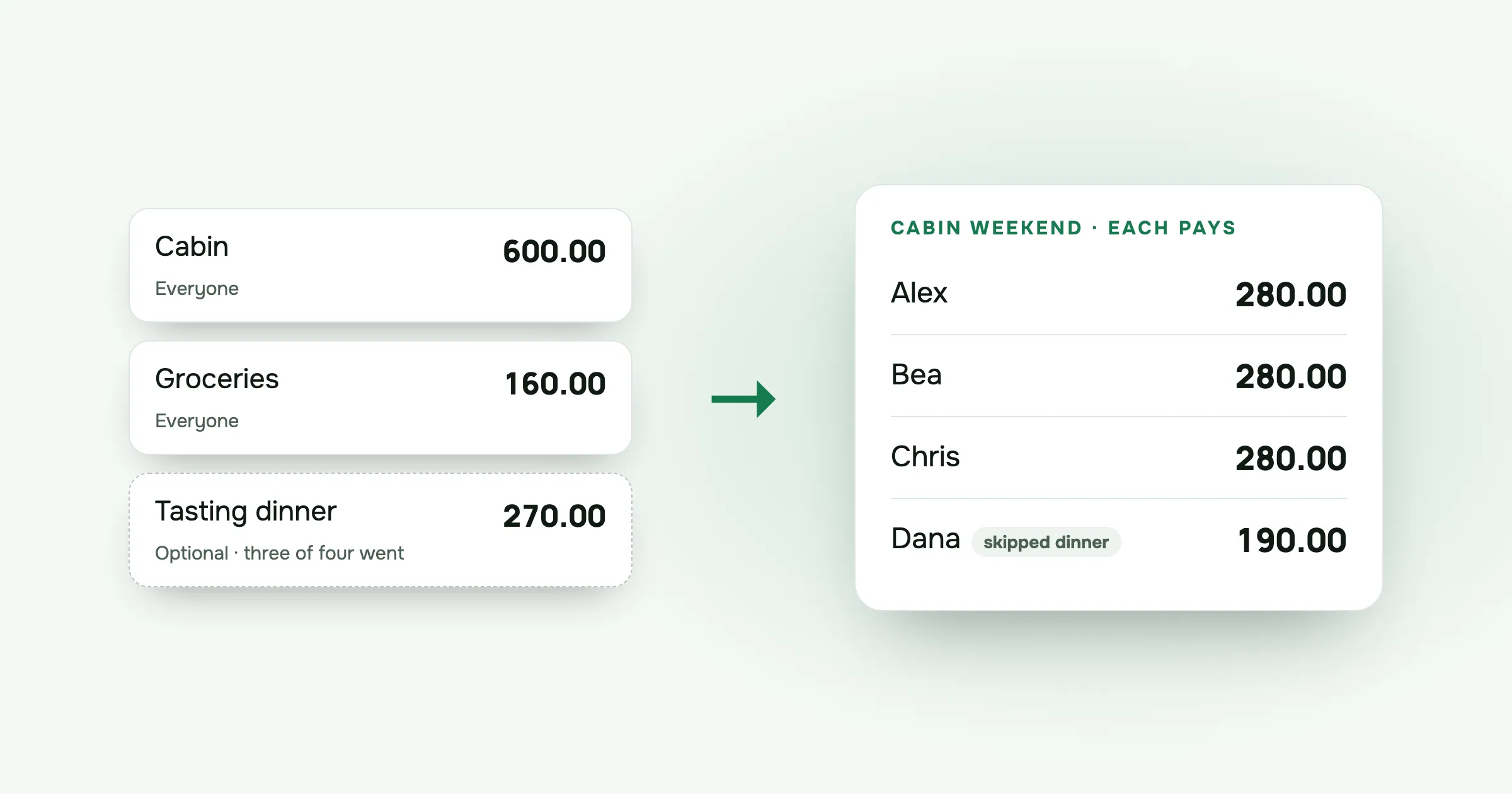
Four friends plan a weekend away. Alex suggests a cabin with a hot tub and a tasting dinner on the Saturday. Two of the others say “sounds great” straight away. Dana, who’s in the second year of a PhD, says nothing for a day and then replies “I might have to see how work goes”.
Work is fine. The tasting dinner is 90.00 a head and Dana’s food budget for the whole month is not much more than that.
Friend groups mix students, people on their first salary, people with kids and people with very comfortable jobs. Splitting everything equally sounds fair, but it can quietly price someone out. Here are ways to handle it that keep everyone on the trip and nobody under a spotlight.
Talk budget before anything is booked
Most of the awkwardness comes from a cost that appears after it’s been decided. Once the cabin is booked and the dinner is reserved, saying “I can’t afford that” feels like spoiling it for everyone.
Before booking, the organiser sends a short message:
Thinking of a weekend in the hills in May. Rough idea: cabin about 150 each for two nights, plus food and petrol. Could everyone message me privately with what’s comfortable? Totally fine to say less.
Two things matter here. Give a number, so people react to something real. And ask for replies privately, so nobody has to say their limit in front of the group. Plan around the lowest number you get, and don’t tell the group whose it was.
Split the basics, make the extras optional
The simplest method, and the one most groups end up with: the things everyone needs are split equally, and the expensive extras are optional.
- Shared by everyone: accommodation, petrol, the big grocery shop.
- Optional: the tasting dinner, the boat hire, the cocktail bar, the spa.
Whoever wants the extra pays for it. Whoever skips it does something else and pays nothing for it. Nobody needs to explain why.
In split-cash, each expense has its own list of people. When whoever pays for the dinner adds it, they untick Dana, and the cost is split between the three who went. Dana’s balance doesn’t move.
Offer tiers instead of one plan
For bigger costs, give people a choice from the start. A city trip can work with two levels of room: a few people take the hotel with the rooftop bar, others take the cheaper place five minutes away. A concert can have seats for some and standing tickets for others.
Record each person’s choice for what it actually cost. If one person books all the tickets, add them as one expense and split by Amounts, typing each person’s ticket price. Everyone pays their own tier without the cheaper option looking like the odd one out.
A percent split, agreed openly
Some groups, often old friends with a big income gap, decide that shared costs should be split by percent. One person pays 30% of the cabin, another 20%.
This can work well, with two conditions. It has to be offered by the people paying more, not requested from them. And the whole group has to agree it out loud before booking, so nobody discovers it in the numbers later.
In split-cash, choose Percent on the expense and type each person’s part. For a 600.00 cabin split 30, 30, 20 and 20, that’s 180.00, 180.00, 120.00 and 120.00.
The friend who wants to treat everyone
Sometimes the friend who earns more simply wants to pay for something. A round of drinks, the first night’s dinner, the hot tub upgrade.
Let them, and keep it out of the app. If they pay for something as a gift, don’t add it as a shared expense. A gift is easier to accept than a discount, and nobody ends up with a smaller balance that hints at why.
The other way round matters too. Nobody should feel they owe a treat back. If you’re on a tight budget and a friend buys the round, “thanks” is the whole repayment.
A worked example
Alex, Bea, Chris and Dana go away for two nights. They agree that the cabin and groceries are shared equally, and the tasting dinner is optional. Dana skips it.
| Expense | Paid by | Split between | Each |
|---|---|---|---|
| Cabin, 2 nights: 600.00 | Alex | all four | 150.00 |
| Groceries: 160.00 | Bea | all four | 40.00 |
| Tasting dinner: 270.00 | Chris | Alex, Bea, Chris | 90.00 |
Each person’s share:
- Alex, Bea and Chris: 150.00 + 40.00 + 90.00 = 280.00 each.
- Dana: 150.00 + 40.00 = 190.00.
Check it: 3 × 280.00 + 190.00 = 1,030.00, and 600.00 + 160.00 + 270.00 = 1,030.00.
Dana pays 90.00 less than the others because she didn’t go to the dinner. Nobody gave her a discount and nobody had to discuss it.
How to raise it without embarrassing anyone
If you’re the one on the tighter budget:
- Say it early and briefly. “I’m keeping this trip under 200, so I’ll skip the dinner and meet you after” is enough. People respect a clear number.
- Suggest instead of just declining. “Could we do one night out at the pizza place and cook the other?” helps the plan rather than leaving a gap.
If you’re organising:
- Ask everyone the same question. Never message only the person you think might struggle.
- Make skipping normal. Build at least one optional item into every plan, so opting out is part of the design.
- Keep the numbers visible. When everyone can see the costs in a shared group, nobody has to ask “what did that come to?” in front of others.
For the rest of the trip mechanics, see how to split trip costs with friends.
Questions people ask
How do you split costs with friends who earn different amounts? Split the basics equally and make the expensive extras optional, so people only pay for what they choose. If the gap is big and everyone agrees, a percent split on shared costs also works, as long as it’s discussed openly.
Should friends who earn more pay more on a group trip? Only if they offer and everyone is comfortable with it. Most groups prefer equal shares for the basics and a choice on the extras. A friend who wants to treat the group can simply pay for something as a gift.
How do you bring up money with friends without embarrassing anyone? Talk about the budget for the plan, not about anyone’s salary. Ask everyone for a comfortable maximum privately, plan around the lowest number, and never single out the person with the tightest budget.
How do you set a budget for a group trip? Before anything is booked, share a rough cost per person for accommodation, travel and food, and ask everyone to reply privately with what works for them. Then book what fits the group.
Planning something with friends on different budgets? Make a group in split-cash and leave people out of the parts they skip. It’s free, with no ads.
 Sabir Shaykhlislamov Built split-cash