How to split costs on a family holiday with grandparents
A fair way to share costs on a family holiday with grandparents, parents and kids, including when the grandparents pay for the house as a gift.
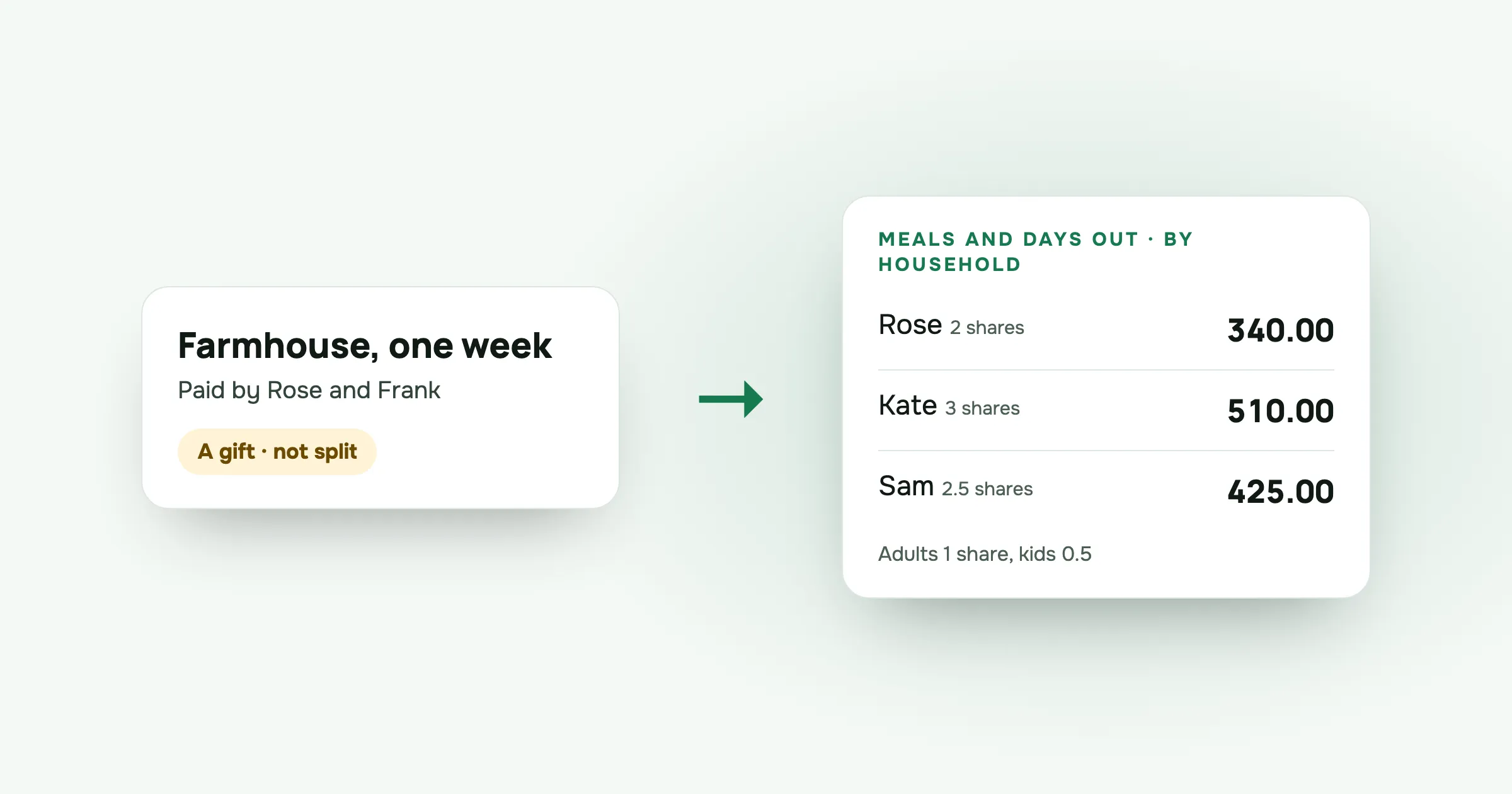
Rose and Frank wanted the whole family together for their fortieth anniversary, so they rented a farmhouse for a week and told everyone it was their treat. Their daughter Kate came with Tom and their two kids, aged nine and six. Their son Sam came with Leah and their four-year-old.
The house was paid for. Everything else wasn’t. By Tuesday, Kate had done two big supermarket runs, Sam had paid for a long lunch at the harbour, and Rose kept buying ice creams and refusing to say how much they cost.
Families rarely argue about money on holiday. They avoid the subject, someone quietly pays more than their part, and it surfaces at Christmas. Agreeing a simple method at the start avoids that.
Split by household, not by head
On a holiday with friends, each person is usually one unit. On a family holiday, the natural unit is the household. Kate and Tom pay for themselves and their kids from the same money, and nobody expects a six-year-old to settle up.
So the shared costs are split between households, weighted by who is in each one.
Do kids count in the split?
Yes, but usually as part of a person. A common rule:
- Babies and toddlers: 0. They eat from their parents’ plates and travel free.
- Children: 0.5. They eat less, get child tickets and drink no wine.
- Teenagers: 1. A fifteen-year-old eats more than most adults.
Agree the ages before the trip. “Under 12 counts as half” is clear enough, and nobody has to argue about one child’s appetite.
For Rose and Frank’s family:
- Rose and Frank: 2 adults = 2 shares
- Kate’s household: 2 adults + 2 children at 0.5 = 3 shares
- Sam’s household: 2 adults + 1 child at 0.5 = 2.5 shares
That’s 7.5 shares in total.
How to set it up in split-cash
There’s no “household” button. You model one in the way that’s easiest for your family. The practical way is one member per household:
- Make a group for the holiday and add one adult from each household: Rose, Kate and Sam. You can add them by name before they sign up, and their costs are waiting when they join.
- When you add a shared expense, choose Shares and give each person their household’s number: Rose 2, Kate 3, Sam 2.5. Shares accept decimals, so 2.5 works.
- If Tom or Leah pays for something, enter it as paid by Kate or Sam. It’s their household’s money either way.
You could add every adult as their own member instead, but then the kids’ shares have to sit with one parent, and couples end up owing each other. One member per household keeps three balances and very few transfers.
When the grandparents pay for something as a gift
If the grandparents pay for the house and call it a present, don’t enter it as a shared expense. A gift isn’t a cost anyone owes back. If you add it, the app will show Kate and Sam owing their parents for a holiday they were given, which is exactly what Rose and Frank didn’t want.
So the house stays out of the group. If the family wants it remembered, a thank-you in the family chat is enough.
The same applies to smaller treats. Rose’s ice creams and the round of drinks Frank insists on buying don’t need to be recorded. Only enter what the family agreed to share.
What does get shared
Once the gift is left out, the shared costs are usually:
- groceries and supermarket runs
- meals out
- petrol for trips the whole family takes together
- tickets for things the whole family goes to
Things one household does on its own, like a day trip Sam’s family takes to a zoo, stay with that household and don’t go in the group.
A worked example
Rose and Frank paid for the farmhouse as their gift, so it isn’t in the group. Three costs are shared, all by household shares: Rose 2, Kate 3, Sam 2.5.
| Expense | Paid by | Per share | Rose (2) | Kate (3) | Sam (2.5) |
|---|---|---|---|---|---|
| Groceries: 600.00 | Kate | 80.00 | 160.00 | 240.00 | 200.00 |
| Harbour lunch: 450.00 | Sam | 60.00 | 120.00 | 180.00 | 150.00 |
| Boat trip: 225.00 | Rose | 30.00 | 60.00 | 90.00 | 75.00 |
Each per-share figure is the cost divided by 7.5. For the groceries, 600.00 ÷ 7.5 = 80.00.
Each household’s total:
- Rose: 160.00 + 120.00 + 60.00 = 340.00
- Kate: 240.00 + 180.00 + 90.00 = 510.00
- Sam: 200.00 + 150.00 + 75.00 = 425.00
Check it: 340.00 + 510.00 + 425.00 = 1,275.00, and 600.00 + 450.00 + 225.00 = 1,275.00.
Balances, which is what each household paid minus its share:
- Rose: 225.00 − 340.00 = −115.00
- Kate: 600.00 − 510.00 = +90.00
- Sam: 450.00 − 425.00 = +25.00
They add up to zero. Settle up shows two transfers: Rose pays Kate 90.00 and Sam 25.00.
If Rose and Frank would like to pay for the food as well, that’s another gift. The simplest way is to let them pay those bills themselves and leave them out of the group, like the house.
Making it easy for every generation
Not everyone in a family is comfortable with apps. A few things help:
- One person per household handles it. Usually the adult who already does the family’s admin. Grandparents don’t need to touch the app if they don’t want to.
- It runs in the browser. Nobody has to install anything. Send the invite link, and anyone who wants quick access can add it to their home screen.
- Photograph receipts. Snap the supermarket receipt and attach it to the expense, so nobody wonders what 600.00 of groceries looked like.
- Settle at the end. Families don’t need to pay each other daily. Settle up on the last evening, and use How to pay me so everyone has the right bank details.
For trips with friends rather than family, see how to split trip costs with friends.
Questions people ask
How do you split costs on a family holiday with grandparents? Treat each household as one unit and split shared costs by household shares. Adults count as 1 and children as 0.5. If the grandparents pay for something as a gift, leave it out of the shared costs entirely.
Do kids count in the split on a family holiday? Usually as half. Babies and toddlers who eat from their parents’ plates count as 0, children count as 0.5, and teenagers who eat like adults count as 1. Agree the ages before the trip.
How do you record a gift from the grandparents? Don’t record it as a shared expense. If the grandparents pay for the house as a present, it isn’t a cost anyone owes them, so it stays out of the group. A thank-you in the family chat is the only record it needs.
Should each household pay the same on a multigenerational holiday? Not if households are different sizes. A couple of grandparents and a family of four eat very different amounts. Split by shares so each household pays for the people in it.
Planning a holiday with the whole family? Make a group in split-cash, add one person per household and send the link. It’s free, with no ads.
 Sabir Shaykhlislamov Built split-cash