How to split party and BBQ costs with friends
Split a house party or BBQ fairly: food, drinks, decorations and the venue, a separate drinks expense for non-drinkers, and collecting from guests.
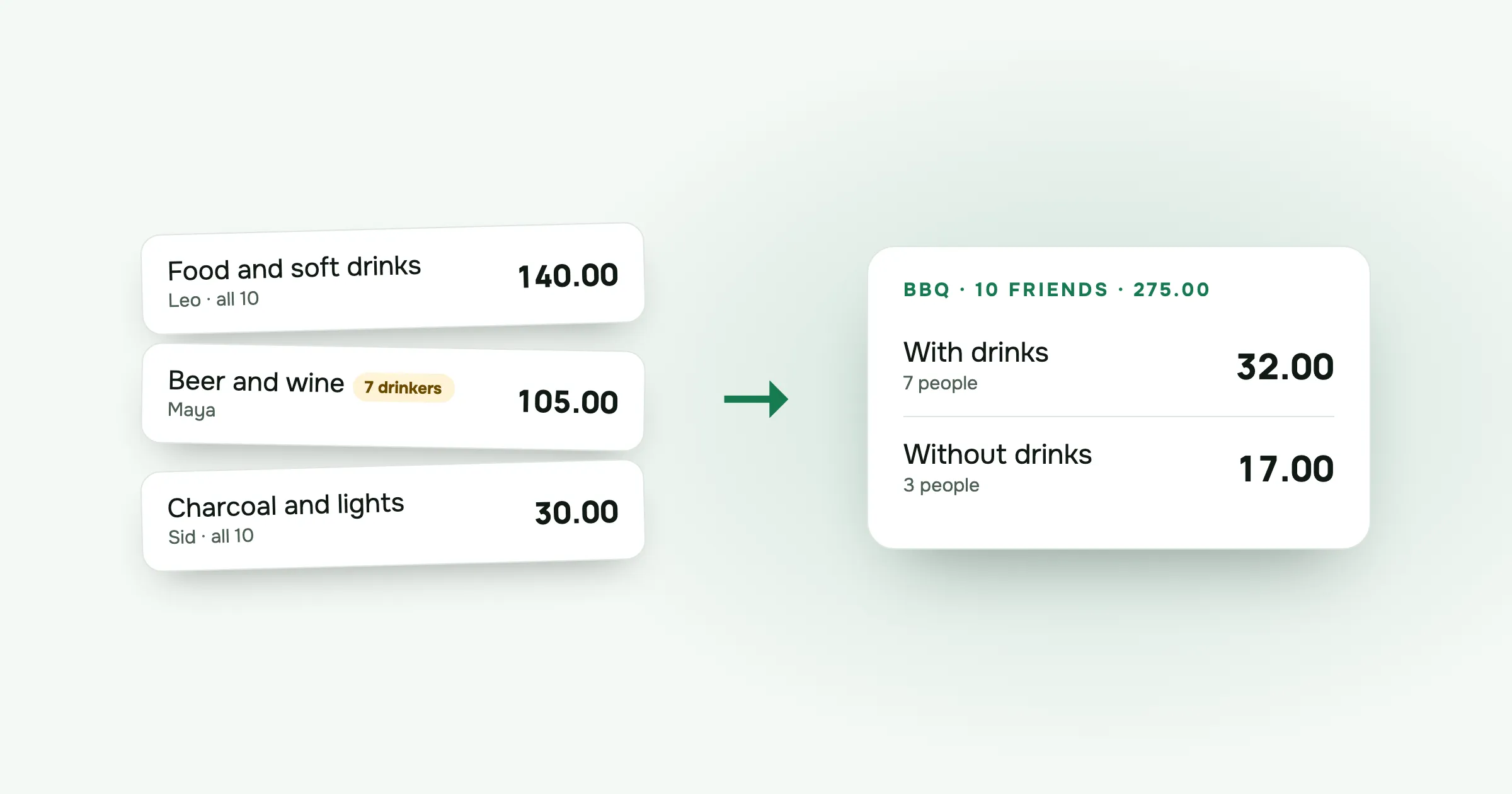
Leo offered his garden for the end-of-summer BBQ. Maya said she’d sort the drinks. Sid picked up charcoal, paper plates and a string of lights. Ten people came, three of them didn’t drink, and by midnight the grill was cold and three people had a pocket full of receipts.
Splitting a party is easy to put off. The money is spread across a few people, nobody wants to chase friends for a sausage, and a week later nobody remembers who bought the ice. A few minutes the next morning sorts it.
Decide who’s paying before you shop
There are two common set-ups, and the split depends on which one you’re running.
- The hosts pay. A few friends throw the party, split the costs between themselves, and guests come for free. Typical for a birthday or a housewarming.
- Everyone chips in. The organisers do the shopping, and everyone who comes pays an equal part. Typical for a BBQ or a party among a group of friends.
Say which one it is in the invitation. “BBQ at Leo’s, we’ll split the costs after” is enough. Nobody minds paying when they knew in advance. People mind a surprise request for money after a party they thought they were invited to.
If it’s someone’s birthday, leave them out of the split. Untick them on each expense and the others cover their part.
The four kinds of cost
Most parties come down to four things.
The venue or house. If the party is at someone’s home or garden, nobody pays for that. The host gives the space and usually ends up doing most of the clearing up, which is their contribution. If you hire a room, a pitch or a park shelter, it’s a cost like any other and gets split between everyone.
Food. Meat, veggie options, buns, salads, crisps and soft drinks. Everyone eats, so everyone pays. Put soft drinks here too, since the people who don’t drink alcohol have them as well.
Drinks. Beer, wine and spirits. Only the people who drank pay. More on this below.
Decorations and supplies. Charcoal, plates, cups, napkins, lights, balloons, ice. Split between everyone.
Leave out anything the host keeps. If Leo buys a new grill for the party, it’s his grill. If he buys a bag of charcoal and half of it is left, most groups let it go.
Non-drinkers get a separate drinks expense
The most common complaint after a party is from the person who drank orange juice all evening and was asked for the same amount as everyone else.
The fix is to keep alcohol out of the food expense:
- Food and soft drinks, split between everyone.
- Alcohol, split only between the people who drank.
In split-cash, add the alcohol as its own expense and untick the people who didn’t drink. It takes a few seconds and stops the argument before it starts.
Some groups go further and split drinks by how much people had. That’s rarely worth it at a party. Drank or didn’t drink is close enough.
A worked example
Ten friends at Leo’s BBQ: Leo, Maya, Sid, Ana, Ben, Cara, Dan, Eli, Fay and Gus. Cara, Eli and Gus don’t drink.
| Expense | Paid by | Split between | Per person |
|---|---|---|---|
| Food and soft drinks: 140.00 | Leo | All 10 | 14.00 |
| Beer and wine: 105.00 | Maya | 7 drinkers | 15.00 |
| Charcoal, plates and lights: 30.00 | Sid | All 10 | 3.00 |
The party cost 275.00 in total.
- A guest who drank pays 14.00 + 15.00 + 3.00 = 32.00.
- A guest who didn’t drink pays 14.00 + 3.00 = 17.00.
Check it: 7 × 32.00 + 3 × 17.00 = 224.00 + 51.00 = 275.00.
Under a single equal split, everyone would have paid 27.50, and each non-drinker would have paid 10.50 towards beer and wine they didn’t have.
Now compare what each person paid with their share:
| Paid | Share | Balance | |
|---|---|---|---|
| Leo | 140.00 | 32.00 | +108.00 |
| Maya | 105.00 | 32.00 | +73.00 |
| Sid | 30.00 | 32.00 | −2.00 |
| Ana, Ben, Dan, Fay | 0.00 | 32.00 each | −32.00 each |
| Cara, Eli, Gus | 0.00 | 17.00 each | −17.00 each |
Leo and Maya are owed 108.00 + 73.00 = 181.00. Everyone else owes 2.00 + 4 × 32.00 + 3 × 17.00 = 181.00. The balances add up to zero.
Sid bought supplies, but his share is still 2.00 more than he spent, so he owes a little too. Settle up works out the fewest transfers to get Leo and Maya their money, so nobody has to work out who pays whom.
Collecting from guests afterwards
This is the part people dread. A few habits make it painless.
Add the receipts the next morning. Each person who shopped adds what they paid, from their own phone, with a photo of the receipt attached. Don’t wait a week. The longer you leave it, the more the request feels like a bill.
Add guests by name. Not everyone at the party will have signed up. Add them to the group by name, then send the invite link to the party chat. Anyone who joins from it sees their own balance in the browser, and can add the app to their home screen if they like.
Make paying easy. Leo and Maya add How to pay me details, so guests know where to send the money without asking.
Mark payments as they arrive. When Ana sends her 32.00, tap Mark as paid. If Ben sends 20.00 now and the rest on payday, that works too, since partial payments are allowed.
Nudge, don’t chase. For anyone who hasn’t paid after a few days, Remind opens the phone’s share menu so you can send a short message in whatever app you use.
If everyone splits everything equally and you don’t want a group for one party, the who owes who calculator works without an account. Type what each person spent and it lists the transfers.
Collecting up front instead
For a bigger party where you don’t know exactly who’ll turn up, some organisers ask for a fixed amount in advance, say 25.00 a head, and buy with that. It’s simpler on the night but harder to get right, and someone always pays for a party they then skip. For a group of friends, buying first and splitting afterwards is usually fairer.
Questions people ask
How do you split the cost of a house party? Add each purchase as its own expense, paid by whoever bought it. Split food and decorations between everyone who came, and drinks only between the people who drank. Then each guest pays back the people who did the shopping.
Should non-drinkers pay for alcohol at a party? No. Record the alcohol as a separate expense and leave the non-drinkers out of it. Soft drinks can go in with the food, since everyone has them.
Should the host pay less for a party at their house? No. They pay the same share of food and drinks as everyone else, and nobody is charged for the house. The host gives the space and does most of the clearing up, and that evens it out.
How do you collect money from guests after a party? Tell everyone their amount within a day or two, along with how to pay you. A shared group where each guest sees their own balance saves you writing a separate message to everyone.
Throwing a party this weekend? Make a group in split-cash and add the receipts the morning after. It’s free, with no ads.
 Sabir Shaykhlislamov Built split-cash