Backpacking with friends: how to handle money over weeks and countries
How to share costs on a long backpacking trip with friends: when to settle, how to deal with several currencies, cash, ATM fees and days spent apart.
Day ten, a hostel rooftop in Chiang Mai. Ali, Bea and Cal have been travelling together since Bangkok, and Bea has just tried to work out where they stand. Her notes app says “Cal tuk-tuk 300?”, “Ali guesthouse x4 nights” and “train, me”. Cal thinks he’s owed a lot. Ali thinks they’re about even. Bea suspects she owes someone money but couldn’t say who, or whether it’s 400 baht or 4,000.
They have seven more weeks to go, across two more countries.
A weekend away can survive loose accounting. A long trip can’t, because the amounts grow, memories fade, and by the end the numbers are a guess. It needs a little more structure, mostly about timing and currencies.
Shared costs, personal costs
On most backpacking trips:
- Shared: rooms, transport you take together, meals you eat together, group activities, taxis and tuk-tuks.
- Personal: your own snacks, souvenirs, clothes, a massage, your SIM card, anything only you used.
Personal costs stay out of the group entirely, unless one person pays for another. Then add it as an expense paid by the payer, with only the other person ticked.
Settle every week, or at every border
On a two-week holiday, you settle at the end. On a two-month trip, don’t wait. Settle every Sunday, or each time you leave a country.
Settling often keeps balances small, so nobody spends six weeks quietly owed money. Everyone still remembers the costs, and you can pay each other in local cash before you cross the border instead of carrying leftover notes.
When you settle, open Settle up, make the transfers and tap Mark as paid. Partial payments work too, so if someone can only pay part now, mark what they paid and the rest stays on the plan.
Currencies: two honest options
Each split-cash group has one currency, and split-cash doesn’t convert between currencies. On a trip across several countries, you choose one of two methods.
One group per currency. Make a group in Thai baht for Thailand, then a new one in Malaysian ringgit when you cross. Every cost goes in exactly as it was paid, with no exchange rates. You settle each group before you leave that country, and archive it. This suits long trips where most spending is local, often in cash. The catch comes at the border: if someone hasn’t got enough local cash to pay what they owe, the two people agree a rate and the rest goes by bank transfer in your home currency.
One group in your home currency. Keep one group in euros, pounds or whatever you’re paid in, and enter each cost as the amount your bank actually charged. For card payments, that’s the figure in your banking app. For cash, work out the rate you got at the ATM, which is what your account was charged divided by the cash you received. This suits trips where most costs are paid by card, or where you’d rather settle once at the end.
Both are fair: the first means no conversions, the second means one set of balances for the whole trip. The details, with an example, are in how to split expenses in multiple currencies.
split-cash supports a fixed list of currencies. If a country’s currency isn’t on it, record that leg in your home currency.
Cash withdrawals and ATM fees
Taking cash out of an ATM doesn’t go in the group. Nobody has spent anything yet. What the cash buys does.
When Cal withdraws cash and pays for street food for the three of them, add the meal as an expense paid by Cal. If he pays for lots of small things in a day, add one expense for the day, like “Tuesday street food and tuk-tuks”, rather than eleven entries.
ATM fees depend on who the cash was for:
- Cash for shared costs: the fee is part of the cost. Add it as its own expense, split between the same people.
- Cash for personal spending: the fee belongs to whoever took it out.
- A mix: share the fee if most of the cash went on shared costs, or agree that whoever withdraws pays their own fees and takes turns.
If you’re handing over cash for every coffee and bus ticket, a shared kitty can be easier for the small stuff. See travel kitty or app for how to record one so it ends at zero.
Splitting up for a few days
On a long trip, people go their own ways for a while. Two head to the islands while one goes trekking. You don’t need a new group. Keep adding costs, and untick whoever isn’t there. The island bungalow is split between the two who stayed in it. The trek is personal, so it stays out. When everyone meets up again, the balances already account for the days apart.
When there’s no signal
split-cash runs in the browser and can be added to your home screen. Without a connection, it shows the latest data it loaded, but adding a new cost needs a connection. On a long bus ride or a remote island, photograph the receipt or jot down the amount, and add it when you’re back on Wi-Fi.
A worked example
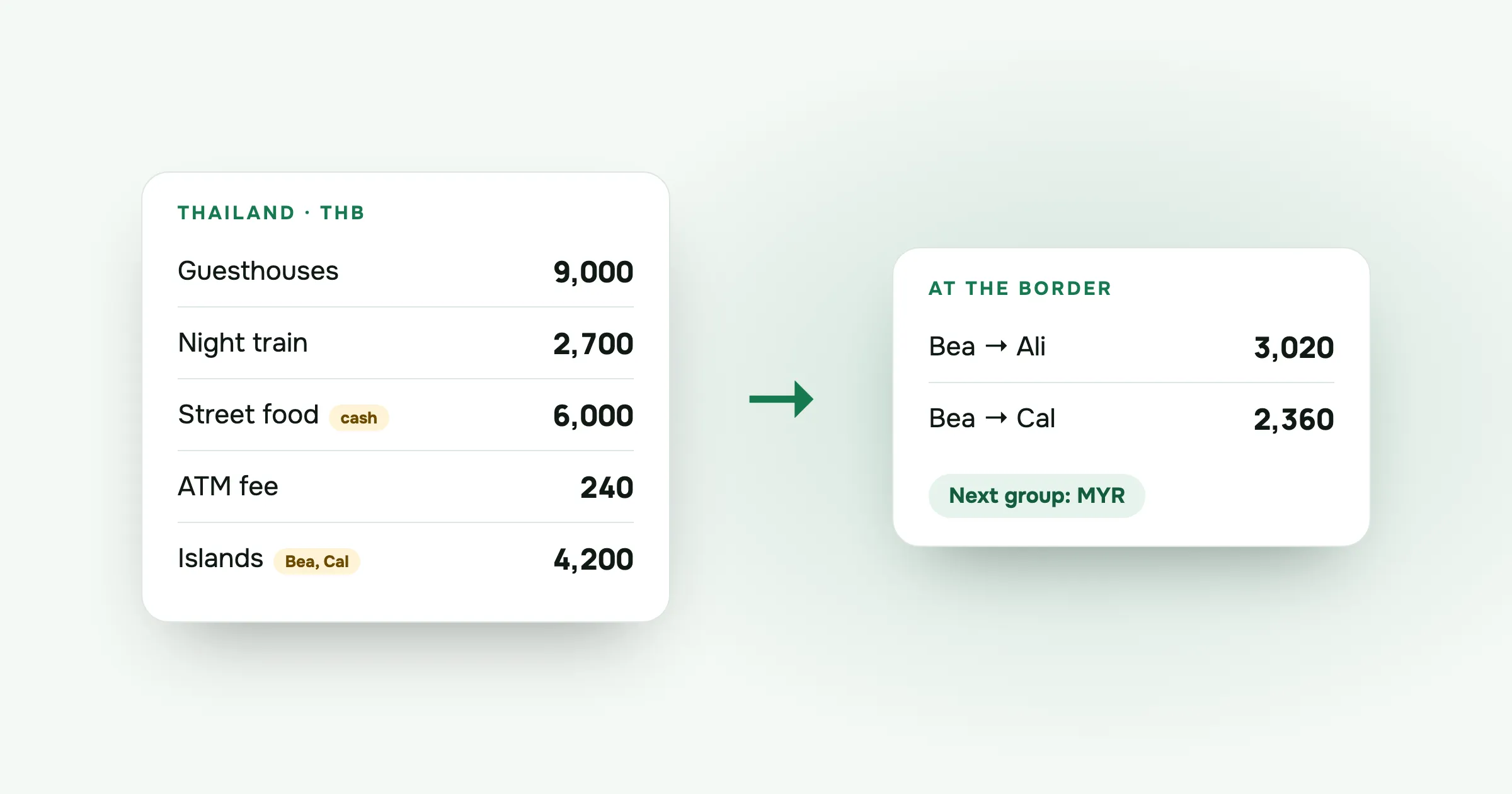
Ali, Bea and Cal spend two weeks in Thailand, in a group set to Thai baht. For three of those days, Bea and Cal go to the islands and Ali goes trekking on his own.
| Expense | Paid by | Amount (THB) | Split between | Each |
|---|---|---|---|---|
| Guesthouses | Ali | 9,000 | all three | 3,000 |
| Night train | Bea | 2,700 | all three | 900 |
| Street food and tuk-tuks, cash | Cal | 6,000 | all three | 2,000 |
| ATM fee for that cash | Cal | 240 | all three | 80 |
| Island ferry and bungalow | Cal | 4,200 | Bea, Cal | 2,100 |
| Total | 22,140 |
Ali’s trek isn’t in the group. He paid for it himself, and it was only for him.
Check the total: 9,000 + 2,700 + 6,000 + 240 + 4,200 = 22,140.
Each person’s share:
- Ali: 3,000 + 900 + 2,000 + 80 = 5,980
- Bea: 3,000 + 900 + 2,000 + 80 + 2,100 = 8,080
- Cal: 3,000 + 900 + 2,000 + 80 + 2,100 = 8,080
Check it: 5,980 + 8,080 + 8,080 = 22,140.
What each paid: Ali 9,000, Bea 2,700, and Cal 6,000 + 240 + 4,200 = 10,440.
Balances, what each paid minus their share:
- Ali: 9,000 − 5,980 = +3,020
- Bea: 2,700 − 8,080 = −5,380
- Cal: 10,440 − 8,080 = +2,360
They add up to zero. Settle up shows two transfers: Bea pays Ali 3,020 baht and Cal 2,360 baht.
They settle the night before the bus to Malaysia. Bea still has enough baht from her last withdrawal, so she pays both in cash, and Ali and Cal tap Mark as paid. They archive the Thailand group and make a new one in ringgit. If they want one record of the whole trip afterwards, each group exports to CSV.
Questions people ask
How do friends handle money when backpacking together? Record every shared cost as it happens, by whoever paid, and keep personal spending out of it. Settle up regularly, every week or at each border, so nobody carries a large debt for the whole trip.
How often should you settle up on a long trip? Every week, or each time you leave a country. Balances stay small, everyone still remembers the costs, and you can use local cash you’d otherwise carry over the border.
How do you split costs in different currencies when backpacking? Either keep one group per currency and settle each one in that currency, or keep one group in your home currency and enter what your bank charged for each cost. split-cash has one currency per group and doesn’t convert, so you choose one of these two.
Should ATM fees be shared on a group trip? If the cash was for shared costs, yes. Add the fee as an expense split between the same people. If someone withdrew cash for their own spending, the fee is theirs.
Leaving soon? Make a group in split-cash for your first country and send the link before you fly. It’s free, with no ads.
 Sabir Shaykhlislamov Built split-cash