Travel kitty or app: how to run a shared travel fund with friends
How a group travel kitty works, where it beats tracking every cost, where it goes wrong, and how to record a kitty so the balances end at zero.
Day one of the trip. Four friends stand outside a café and everyone hands Maya a 50 note. For five days she pays every coffee, bus ticket and ice cream from an envelope in her bag. On the last afternoon there are 16 left, and Lea, who doesn’t drink, is quietly wondering how much of the envelope went on beer.
A kitty is the oldest way to share costs on a group trip. It’s great for some things and bad for others.
How a cash kitty works
- Everyone puts the same amount in at the start, for example 50 each.
- One person holds the money.
- Shared costs are paid from it.
- When it runs low, everyone adds the same amount again.
- Whatever is left at the end is divided equally.
Nobody keeps accounts, and that’s the appeal.
What a kitty is good at
Small, frequent costs: coffees, pastries, bus tickets, the 2.00 to use a beach toilet. Recording each one is tedious, and the amounts are too small to argue about. It’s also handy at markets and bars that only take cash, where one person paying beats four people digging for coins.
Where a kitty goes wrong
Someone has to hold the cash. They carry everyone’s money, worry about losing it, and become the group’s accountant whether they wanted to or not.
Top-ups are awkward. When the envelope is empty, someone asks everyone for another 30. One person is short, someone covers them, and now there’s a side debt nobody wrote down.
People who use less pay for people who use more. Everyone puts in the same, so the person who skips the drinks pays for part of everyone else’s. Over a weekend of coffees it doesn’t matter. Over a week of aperitivos it does.
Big costs don’t fit. Nobody carries enough cash for the rental or the dinners, so you need another method for those anyway.
The hybrid: kitty for small things, app for the rest
Most groups that travel together a lot end up with a small kitty for coffees, snacks and cash-only costs, and everything else recorded in an app as it happens: the accommodation, fuel and tolls and dinners.
If you also record what the kitty spends, in the same group, you keep the convenience of one person paying in cash and lose the unfairness. The holder becomes one more person who pays for things, and the app works out who used what.
How to record a kitty in split-cash
Don’t add the 200.00 kitty itself as an expense. Nobody has used anything yet when the money goes in, so it isn’t a cost. This method stays correct:
- Each contribution is a payment from that person to the holder. Jonas gives Maya 50.00, so record a 50.00 payment from Jonas to Maya. The holder’s own contribution doesn’t need recording, since she’s paying herself.
- Everything the kitty buys is an expense paid by the holder, split between the people it was for. Untick anyone who wasn’t part of it.
- The leftover cash sorts itself out. At the end, Settle up shows how much the holder owes each person, which is exactly how the remaining cash should be shared.
A worked example
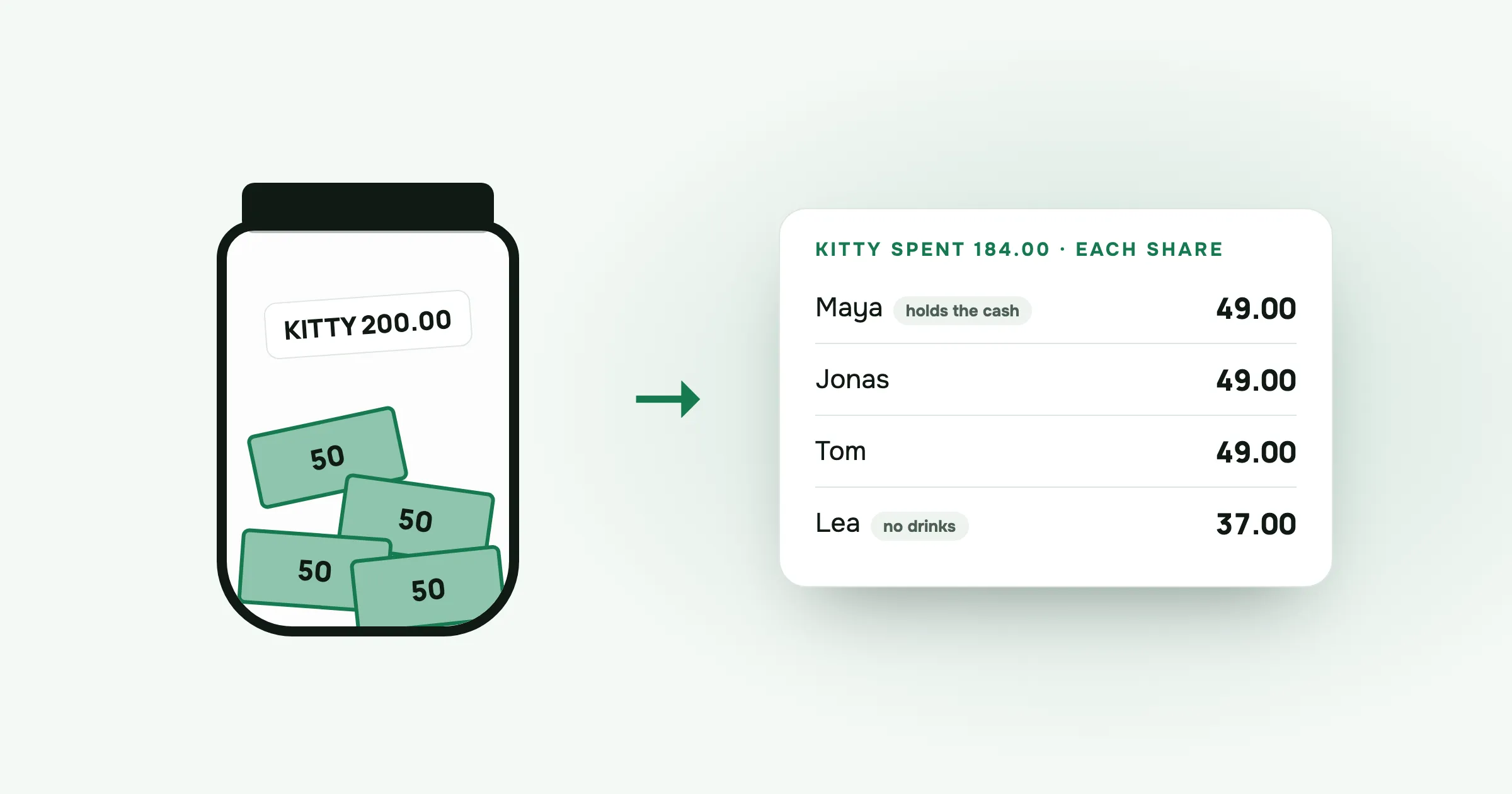
Maya, Jonas, Lea and Tom each put 50.00 into the kitty. Maya holds it. That’s 200.00 in cash.
Maya records three payments: 50.00 from Jonas, 50.00 from Lea and 50.00 from Tom.
During the trip the kitty pays for:
| Expense | Amount | Split between | Each |
|---|---|---|---|
| Coffees and pastries | 96.00 | all four | 24.00 |
| Bus tickets | 32.00 | all four | 8.00 |
| Beer and wine | 36.00 | Maya, Jonas, Tom | 12.00 |
| Ice cream | 20.00 | all four | 5.00 |
| Total | 184.00 |
Maya adds each one as an expense paid by her. On the drinks, Lea is unticked.
Check the spending: 96.00 + 32.00 + 36.00 + 20.00 = 184.00. There’s 200.00 − 184.00 = 16.00 left in the envelope.
Each person’s share of what the kitty bought:
- Maya, Jonas and Tom: 24.00 + 8.00 + 12.00 + 5.00 = 49.00 each.
- Lea: 24.00 + 8.00 + 5.00 = 37.00.
Check it: 3 × 49.00 + 37.00 = 147.00 + 37.00 = 184.00.
Now the balances:
- Jonas put in 50.00 and used 49.00. He gets back 1.00.
- Tom, the same. He gets back 1.00.
- Lea put in 50.00 and used 37.00. She gets back 13.00.
- Maya paid 184.00 from the kitty, received 150.00 from the others, and her own share was 49.00. 184.00 − 150.00 − 49.00 = −15.00, so she owes 15.00.
Check it: 1.00 + 1.00 + 13.00 − 15.00 = 0.00.
Settle up tells Maya to give 1.00 to Jonas, 1.00 to Tom and 13.00 to Lea. That’s 15.00 out of the 16.00 in the envelope. The last 1.00 is Maya’s own, because she put in 50.00 and used 49.00.
With a plain kitty, the 16.00 would have been split four ways, 4.00 each. Lea would have got 4.00 instead of 13.00, so she’d have paid 9.00 towards drinks she never had.
Top-ups and a new holder
A top-up works like the first round: a payment from each person to the holder. If the holder changes halfway, record a payment from the old holder to the new one for the cash handed over.
Keep the kitty in the same group as the rest of the trip. At the end you settle the kitty and the big costs together, in the fewest transfers.
Questions people ask
How does a travel kitty work? Everyone puts the same amount of cash into a shared fund at the start of the trip, and one person holds it. Small shared costs like coffee, bus tickets and snacks are paid from it. When it runs low, everyone tops it up, and whatever is left at the end is shared out.
Is a kitty fair if someone doesn’t drink? Not on its own. Everyone pays the same into the kitty, so people who drink or eat less pay for some of what the others had. If the difference matters, record the kitty’s spending in an app and leave people out of the costs that weren’t theirs.
Who should hold the kitty? Someone organised who doesn’t mind carrying cash and keeping receipts. They don’t need to keep a notebook if they add what the kitty pays for to the group as they go.
What happens to the money left in the kitty? With a plain kitty, it’s split equally. If you record the kitty in split-cash, Settle up shows how much of the leftover cash each person gets back, based on what they actually used.
Holding the kitty on your next trip? Make a group in split-cash and add the contributions before the first coffee. It’s free, with no ads.
 Sabir Shaykhlislamov Built split-cash