How to keep track of who paid what on a trip
What to record each time someone pays on a group trip, how to log cash and costs paid for one person, and when to settle so nothing goes missing.
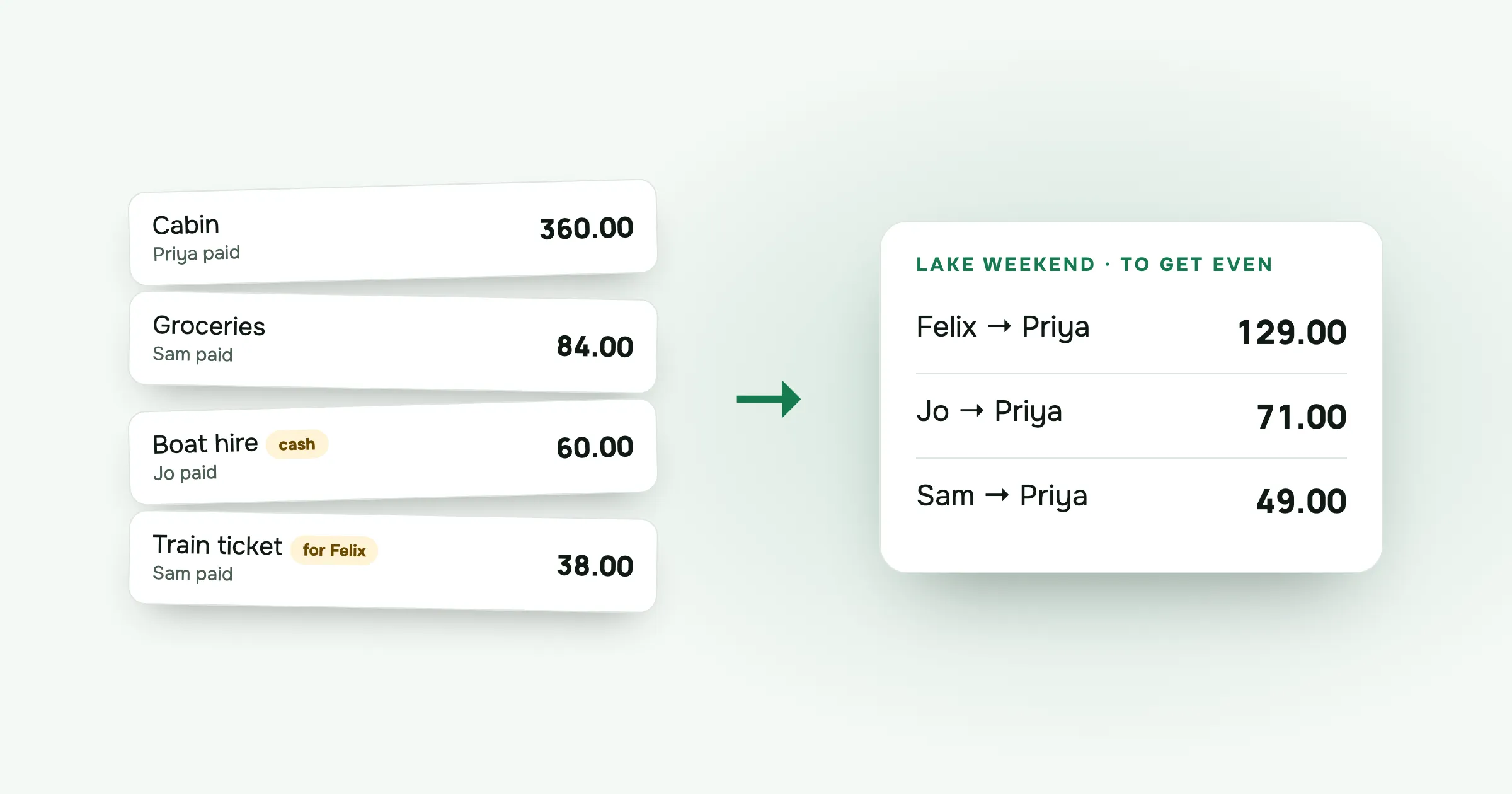
It’s Sunday evening at the lake house. Four friends are trying to remember who paid for the boat. Jo is sure it was her, in cash, but nobody wrote it down. Sam bought Felix’s train ticket on Friday and has half forgotten. Priya has the cabin booking on her card and a vague feeling she’s owed a lot.
The sums are easy. Remembering is the hard part. The groups that settle a trip in five minutes are the ones that wrote things down as they happened, with the same few details each time.
Record four things, every time
Whenever someone pays for something shared, add it with:
- Who paid. Not who suggested it or who carried the bags. Whose card or cash it was.
- How much. The amount actually paid, including the tip if there was one.
- Who shared it. Everyone, or only the people who were there. This is the detail that goes missing first.
- A receipt photo, when there is a receipt. Nobody checks it most of the time. When someone does ask, the photo ends the conversation.
A short description helps too. “Saturday groceries” is easier to recognise a week later than “Shop”.
In split-cash, each expense has a field for who paid and a list of people to share it with, ticked by default. Untick anyone who wasn’t part of it. You can attach a photo of the receipt to the expense. It’s stored with it, not scanned, so the amount you type is the amount that counts.
Record it straight away, from the payer’s phone
The best time to add a cost is while the card is still in your hand. The second best is that evening. Costs left until the last day are the ones that disappear, usually the small ones paid in a hurry: a taxi, a round of drinks, a parking machine.
It also helps if the person who paid adds it themselves. They know the amount, they have the receipt, and they’re the one who wants it recorded. One person making a group and sending the invite link to the group chat means everyone can add their own costs from their own phone. Friends who haven’t signed up yet can be added by name, so nobody is left out while they get round to it.
split-cash runs in the browser and can be added to your home screen like an app. Adding a cost needs a connection, so if you’re somewhere without signal, take a photo of the receipt and add it when you’re back in range.
Cash payments
Cash is where tracking breaks most often, because there’s no bank statement to check later.
Cash spent on something shared is an expense like any other. If Jo pays 60.00 in cash for the boat, add a 60.00 expense paid by Jo. The fact that it was cash doesn’t change anything, it just means nobody can look it up later, so add it now.
Cash handed from one friend to another is a payment. If Felix gives Sam 40.00 in cash towards what he owes, record a 40.00 payment from Felix to Sam. Don’t add it as an expense. Nothing was bought, money just moved between two people, and the payment lowers Felix’s debt and Sam’s credit by the same amount.
When one person pays for another
Sam buys Felix’s train ticket because Felix’s card isn’t working. That’s a cost that belongs entirely to Felix.
Add it as an expense paid by Sam, and untick everyone except Felix. Felix’s balance shows the full 38.00, and it gets settled at the end with everything else. There’s no need for a separate note, a reminder in your head or a bank transfer from the station platform.
The same works for a friend who orders something for themselves on your bill, or a ticket you bought for someone who joins the trip later.
A worked example
Priya, Sam, Jo and Felix spend a long weekend at a lake. Here’s everything they recorded:
| Expense | Paid by | Amount | Shared by | Each |
|---|---|---|---|---|
| Cabin | Priya | 360.00 | all four | 90.00 |
| Groceries | Sam | 84.00 | all four | 21.00 |
| Boat hire (cash) | Jo | 60.00 | Sam, Jo, Felix | 20.00 |
| Felix’s train ticket | Sam | 38.00 | Felix | 38.00 |
| Total | 542.00 |
Priya skipped the boat, so she’s unticked on it. On Saturday, Felix also gave Sam 40.00 in cash, recorded as a payment.
Check the total: 360.00 + 84.00 + 60.00 + 38.00 = 542.00.
Each person’s share:
- Priya: 90.00 + 21.00 = 111.00
- Sam: 90.00 + 21.00 + 20.00 = 131.00
- Jo: 90.00 + 21.00 + 20.00 = 131.00
- Felix: 90.00 + 21.00 + 20.00 + 38.00 = 169.00
Check it: 111.00 + 131.00 + 131.00 + 169.00 = 542.00.
Now the balances, what each person paid minus their share, adjusted for the cash payment:
- Priya paid 360.00. 360.00 − 111.00 = +249.00
- Sam paid 84.00 + 38.00 = 122.00, and received 40.00 from Felix. 122.00 − 131.00 − 40.00 = −49.00
- Jo paid 60.00. 60.00 − 131.00 = −71.00
- Felix paid nothing for the group, and gave Sam 40.00. 0.00 − 169.00 + 40.00 = −129.00
Check it: 249.00 − 49.00 − 71.00 − 129.00 = 0.00.
Settle up gives three transfers, all to Priya: Felix sends 129.00, Jo sends 71.00 and Sam sends 49.00. That’s 249.00, exactly what she’s owed.
When to settle
At the end of the trip, on the last evening or the next day. Everyone still remembers the costs, and the receipts are still in their pockets. Settling a month later means arguing about a boat nobody can picture any more.
Halfway through a long trip, if one person is carrying a lot. On a two-week trip where one friend paid every booking, settling at the midpoint stops them being out of pocket for a fortnight.
When it’s time, open Settle up, make the transfers however you usually pay each other, and tap Mark as paid. Partial payments work too, so if Felix sends 100.00 now and the rest on payday, the remaining 29.00 stays on the plan. Add your bank or payment details under How to pay me so nobody has to ask, and use Remind to send a nudge through whatever app the group uses.
After the trip, archive the group. If you want a copy of everything, export it to CSV. If your group prefers to keep the whole thing in a sheet, the spreadsheet setup is here, and the recording habits above work the same way.
Questions people ask
What should you record when someone pays on a trip? Four things. Who paid, how much, who it was for, and a photo of the receipt if there is one. A short description like “Saturday groceries” helps when someone asks about it a week later.
How do you track cash payments on a group trip? Add a cash cost the same way as a card cost, by whoever handed over the cash, as soon as it’s paid. If one friend gives another cash to pay them back, record it as a payment between the two, so the balances drop by that amount.
How do you record a cost one person paid for someone else? Add it as an expense paid by the person who paid, and untick everyone except the person it was for. Their balance then shows they owe the full amount, and it’s settled with everything else.
When should a group settle up after a trip? On the last day or the day after, while people still remember the costs. Settling halfway through also helps on a long trip, so nobody carries a large balance for weeks.
Going away soon? Make the group in split-cash before you leave and send the link to the group chat. It’s free, with no ads.
 Sabir Shaykhlislamov Built split-cash