Carpool cost sharing: how much to charge and how to settle weekly
How to work out a fair daily cost for a shared commute, from fuel, parking, tolls and wear on the car, and split it weekly between whoever rode.
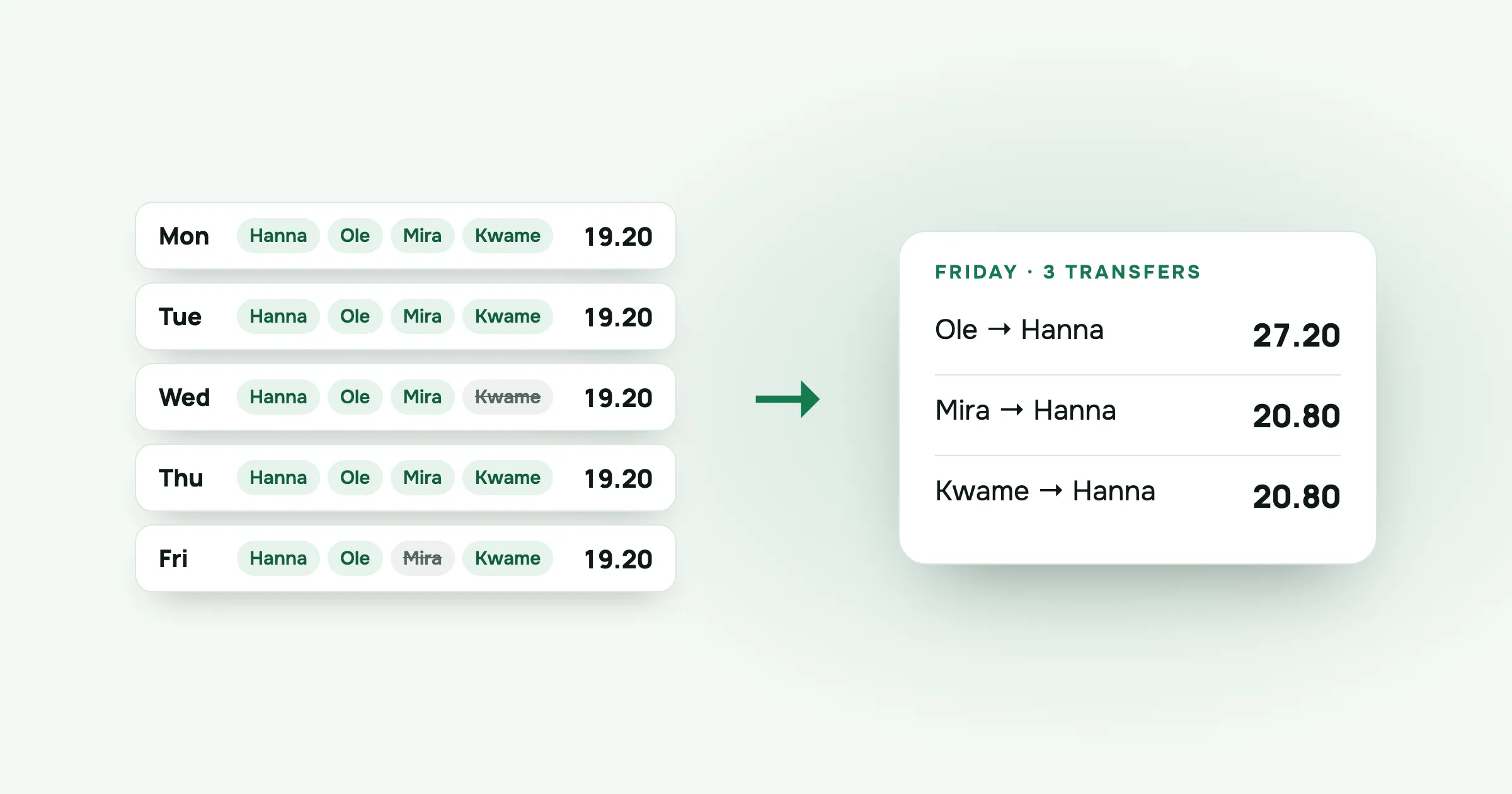
Hanna drives 40 km to work every morning, and so do three people who live a few streets away. In September they start going together. By the second week, Ole has offered “something for fuel” twice, Mira has bought coffee instead, and Kwame, who works from home on Wednesdays, isn’t sure whether he owes anything at all.
A shared commute costs the driver real money every day. When nobody names a number, the driver is the one who ends up paying more than they should.
Here’s how to agree a number once and settle it every Friday without thinking about it.
Work out what one day costs
Start with the cost of one round trip. For a commute, four things go in:
- Fuel. Distance × consumption × fuel price.
- Parking. A daily ticket at work, if there is one.
- Tolls. Any road or bridge tolls on the route.
- Wear on the car. Tyres, servicing and the car losing value with every kilometre.
The free fuel cost calculator takes the distance, your car’s consumption and the fuel price, adds tolls and parking, and gives you the cost of the trip. No account needed.
Wear is harder. There’s no exact figure, so agree one as a group: a small amount per kilometre that the driver thinks is fair. Some groups leave wear out and just cover fuel and parking. Either is fine, as long as everyone knows which you’re doing.
For Hanna’s commute:
- 80 km round trip at 6.0 litres per 100 km uses 4.8 litres. At 1.75 a litre, that’s 8.40.
- Parking at work: 6.00 a day.
- Tolls: none on this route.
- Wear: the group agrees 0.06 per km, so 80 × 0.06 = 4.80.
One day costs 8.40 + 6.00 + 4.80 = 19.20.
How much to charge: split the day between whoever rode
The fairest way is to split each day’s cost between the people in the car that day, driver included. Hanna is commuting too, and driving alone would cost her the full 19.20.
With four people in the car, that’s 19.20 ÷ 4 = 4.80 each. With three, it’s 19.20 ÷ 3 = 6.40 each.
Some groups let the driver pay less, because they bring the car and do the driving. In split-cash, choose Shares and give the driver 0.5 while everyone else gets 1. Or untick the driver so the passengers cover the whole day. Pick one and stick to it.
A flat fare per ride, say 5.00 whoever’s in the car, is simpler to remember. The catch is that the driver comes out short on days with fewer riders, and ahead on full days. Splitting the actual day avoids that, and split-cash does the division anyway.
Days someone didn’t ride: untick them
Record each day as one expense paid by the driver, for the agreed daily cost. Everyone in the carpool is ticked by default. Untick anyone who wasn’t in the car that day: working from home, on holiday, off sick.
The day’s cost is then split between the people who rode, so nobody pays for a lift they didn’t get.
You don’t have to add the days one by one in the morning. It’s often easier to add the whole week on Friday: five expenses in a couple of minutes. split-cash runs in the browser and can be added to your home screen. Adding expenses needs a connection.
Settle up weekly
A week of commuting is a small amount, and small amounts get paid quickly.
On Friday, open Settle up. It shows who owes the driver what, in the fewest transfers. The driver can add How to pay me details, so riders pay without asking for an account number. As each payment comes in, tap Mark as paid. If someone’s slow, Remind opens your phone’s share menu with the amount and a link to the group.
A worked example: one week
Hanna drives all five days. Ole rides every day. Kwame works from home on Wednesday. Mira takes Friday off.
| Day | Paid by | In the car | Each pays |
|---|---|---|---|
| Monday: 19.20 | Hanna | Hanna, Ole, Mira, Kwame | 4.80 |
| Tuesday: 19.20 | Hanna | Hanna, Ole, Mira, Kwame | 4.80 |
| Wednesday: 19.20 | Hanna | Hanna, Ole, Mira | 6.40 |
| Thursday: 19.20 | Hanna | Hanna, Ole, Mira, Kwame | 4.80 |
| Friday: 19.20 | Hanna | Hanna, Ole, Kwame | 6.40 |
The week costs 5 × 19.20 = 96.00.
Each person’s share:
- Hanna: 4.80 + 4.80 + 6.40 + 4.80 + 6.40 = 27.20
- Ole: the same days, 27.20
- Mira: 4.80 + 4.80 + 6.40 + 4.80 = 20.80
- Kwame: 4.80 + 4.80 + 4.80 + 6.40 = 20.80
Check it: 27.20 + 27.20 + 20.80 + 20.80 = 96.00.
The balances:
- Hanna paid 96.00, share 27.20: she’s owed 68.80.
- Ole owes 27.20.
- Mira owes 20.80.
- Kwame owes 20.80.
The three amounts owed add up to 68.80, so the balances total zero. Settle up shows three transfers to Hanna, and the week is done.
When drivers take turns
If two people in the carpool both have cars and take turns, each records the days they drive, paid by them. Ole drives on Thursdays, so Thursday’s expense is paid by Ole. Settle up nets it all out: Ole’s Thursday cancels part of what he owes Hanna, and he only sends the difference.
If the two cars cost different amounts to run, each driver uses their own daily cost.
When fuel prices change
Fuel prices move. Every month or two, run the numbers again with the current price and update the daily cost the group uses. A change of a few cents a litre won’t matter much over one week, but it adds up over a year of commuting.
For one-off trips rather than a daily commute, like a weekend away or a drive to a wedding, see how to split gas on a road trip.
Questions people ask
How much should you charge for a carpool? Charge each rider a share of what the trip costs to run, not a taxi fare. Add up fuel, parking, tolls and any agreed amount for wear on the car, and divide it between the people in the car that day.
Should the carpool driver pay a share? Often, yes, since they’re commuting too. Some groups let the driver pay half a share or nothing for bringing the car. With Shares in split-cash, give the driver 0.5 or untick them.
What about days someone doesn’t ride? Untick them on that day’s expense. The day’s cost is then split between the people who were in the car.
How often should a carpool settle up? Weekly works well. The amounts stay small, nobody has to remember last month, and the driver isn’t paying for everyone’s fuel for weeks at a time.
Sharing the drive to work? Make a group in split-cash, add this week’s days and send the link to your riders. It’s free, with no ads.
 Sabir Shaykhlislamov Built split-cash