How to plan a group trip budget that everyone can afford
Plan a group trip budget per person before anyone books. Agree a range, separate fixed costs from daily spending, add a buffer and check it as you go.
On a Sunday evening, Jules posts a link in the group chat: a villa with a pool, 3,200 for the week. Two people reply within a minute. Kai and Noor don’t reply at all.
Kai and Noor want to come. Neither has said what they can spend, and nobody has asked. By the time someone does, a deposit is paid and the conversation is awkward.
Here’s how to plan a budget that works for everyone before anything is booked, and how to keep to it once you’re there.
Agree a per-person range before anyone books
Before anyone posts a link, ask one question in the group chat: roughly how much can each person spend on this trip, not counting flights?
Ask for a range, like 600 to 700, rather than one number. It’s easier to answer. Anyone who’d rather not say it in front of everyone can message the organiser privately.
Then plan to the lower end of what people said. A trip that fits the tightest budget in the group is one everyone can come on. Anyone with more to spend can spend it on their own extras.
If incomes in the group are very different and you’d like to split some costs in proportion rather than equally, splitting costs between friends with different incomes covers how to do that.
Fixed costs and daily spending
A trip budget has two parts, and it helps to plan them separately.
Fixed costs are known before you leave: accommodation, car hire, a boat trip you’ve booked, ferry tickets.
Daily spending is everything that happens on the trip: groceries, meals out, drinks, fuel, entry tickets, taxis. Estimate it per person per day. Look at what a dinner and a supermarket shop cost where you’re going, and be realistic about how often you’ll eat out.
Once the fixed costs are booked, daily spending is the only part you can still control, and you know exactly how much room there is.
Add a buffer
Something usually costs more than planned. A taxi when the car hire desk is closed, a dinner that turns into a long one, a rainy day that becomes a museum day.
Add about 10% on top of fixed costs and daily spending. If you don’t use it, everyone spends less than they planned, which nobody complains about.
Who books what
Spread the big bookings between a few people, so one person isn’t lending the whole group money for months.
- One person books the accommodation.
- Another books the car.
- Everyone books their own flights. Those stay out of the group, since there’s nothing to split.
Whoever books something records it in split-cash the day they pay, as an expense paid by them and split between everyone it’s for. The bookers can then see what they’re owed long before the trip, and anyone who wants to pay early can.
A worked example: the budget
Five friends, six nights on the coast. They pass on the villa. Asha books a house, Dev books the car, and everyone books their own flights. In the group chat, they agreed 600 to 700 each, flights not included.
| Group | Per person | |
|---|---|---|
| House, 6 nights (booked by Asha) | 1,500.00 | 300.00 |
| Car hire (booked by Dev) | 360.00 | 72.00 |
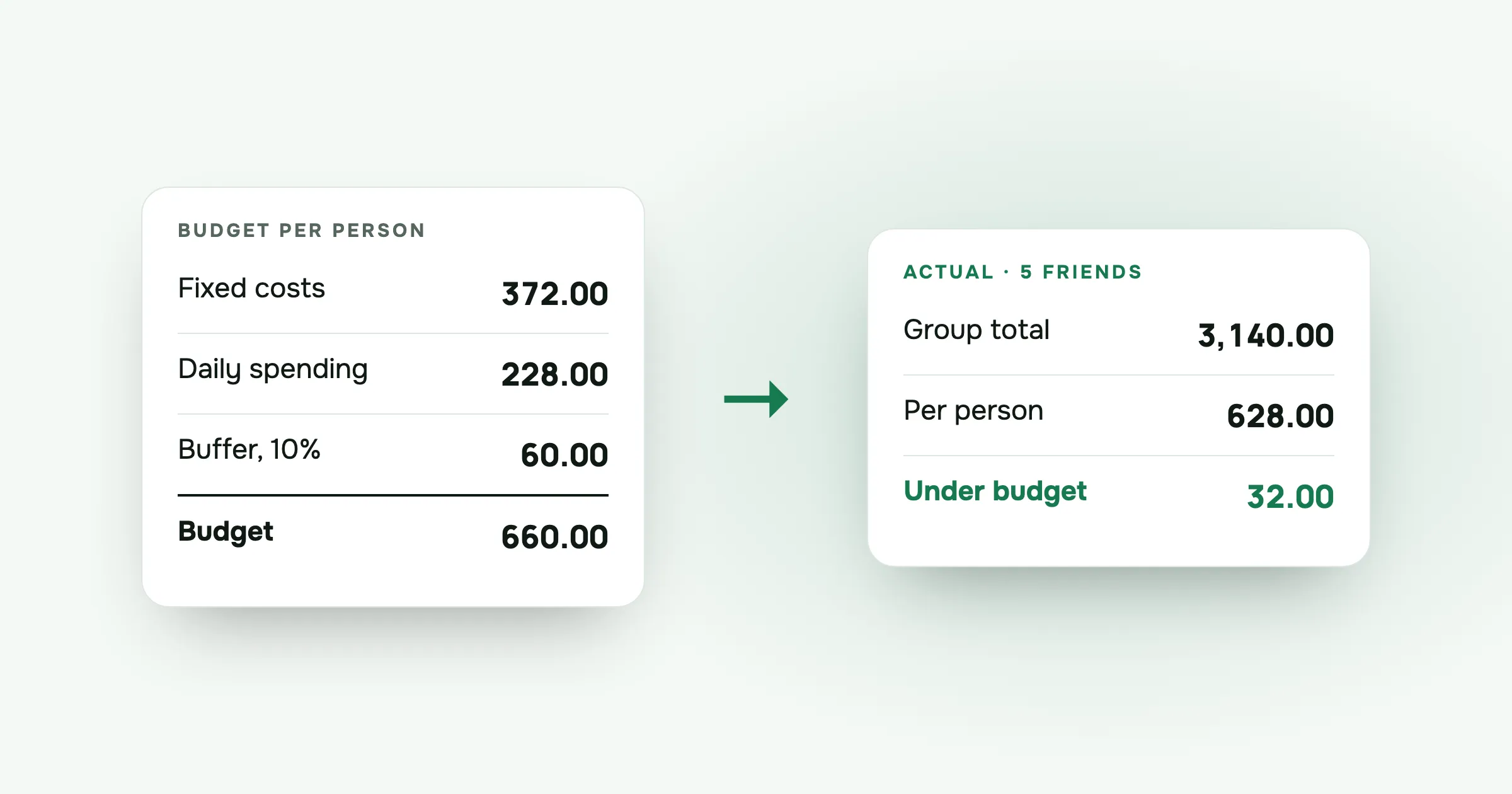
| Fixed costs | 1,860.00 | 372.00 |
| Daily spending, 6 days × 38.00 | 1,140.00 | 228.00 |
| Subtotal | 3,000.00 | 600.00 |
| Buffer, 10% | 300.00 | 60.00 |
| Budget | 3,300.00 | 660.00 |
Check it: 1,500.00 + 360.00 + 1,140.00 = 3,000.00, and 5 × 660.00 = 3,300.00.
660.00 each sits inside the agreed range. The daily spending of 38.00 per person is 190.00 a day for the group, and that’s the number worth watching once they’re there.
Asha and Dev post the table in the group chat and pin it. split-cash doesn’t have a budget feature, so the chat is where the plan lives.
Track costs during the trip and compare
On the trip, record every shared cost as it happens, paid by whoever paid it. The supermarket run, the dinner, the fuel, the entry tickets. Anyone in the group can add an expense and choose who paid, so if someone’s phone is dead, a friend can add it for them.
Every couple of days, compare the group’s total in split-cash with the plan.
At the end of day three, the group’s total is 2,520.00. Take off the fixed costs of 1,860.00 and the daily spending so far is 660.00. The plan for three days was 3 × 190.00 = 570.00.
So they’re 90.00 over on daily spending, which is 18.00 each. That’s well inside the buffer of 300.00. If the next three days cost the same as the first three, 220.00 a day, the trip ends at 1,860.00 + 6 × 220.00 = 3,180.00, or 636.00 each. Still under 660.00.
Nobody needs to cut back. Had they been 400.00 over, they’d have known with half the trip left, while cooking in a couple of nights could still fix it.
Look at the group spending chart at the same time. It shows who paid what, so you can see if one person has been paying for everything.
A spreadsheet for the plan, the app for the spending
A spreadsheet is a good place to plan a trip budget, where it’s easy to try a cheaper house or one fewer night. It’s a bad place to record spending, because nobody opens a shared spreadsheet at a supermarket checkout. An app on everyone’s phone gets the costs in on the day.
If you want both side by side, use the app on the trip and export the group as CSV at the end. Paste it next to your plan and compare line by line. There’s more on the trade-offs in shared expenses: spreadsheet or app.
After the trip
The trip ends at 3,140.00 for the group. Everything was split equally, so that’s 628.00 each, 32.00 under the budget of 660.00.
Open Settle up to see the fewest transfers that square everyone up, including what’s still owed to Asha and Dev for the bookings. Mark each one as paid, and archive the group when everyone is at zero. For the full process of splitting the costs themselves, see how to split trip costs with friends.
Questions people ask
How do you plan a group trip budget? Agree a per-person range in the group chat before anyone books. Then list the fixed costs, like accommodation and car hire, estimate daily spending per person, and add a buffer of about 10%.
How much should a group trip budget be per person? Whatever the person with the tightest budget is comfortable with. Ask for a range before booking and plan to the lower end, so nobody has to drop out or stretch to keep up.
Should flights be part of the group budget? Only if one person books them for everyone. If each person books their own flights, leave them out of the group and agree the budget for everything else.
How do you track spending against a group trip budget? Record every shared cost as it happens, then compare the group’s total with the budget every couple of days. If you want them side by side in a spreadsheet, export the group as CSV.
Planning a trip together? Make a group in split-cash, add the first booking and send the link to everyone. It’s free, with no ads.
 Sabir Shaykhlislamov Built split-cash