How to split Christmas costs with family fairly
Who pays for Christmas dinner, how siblings share a gift for their parents, why travel stays separate, and how to weight households with kids.
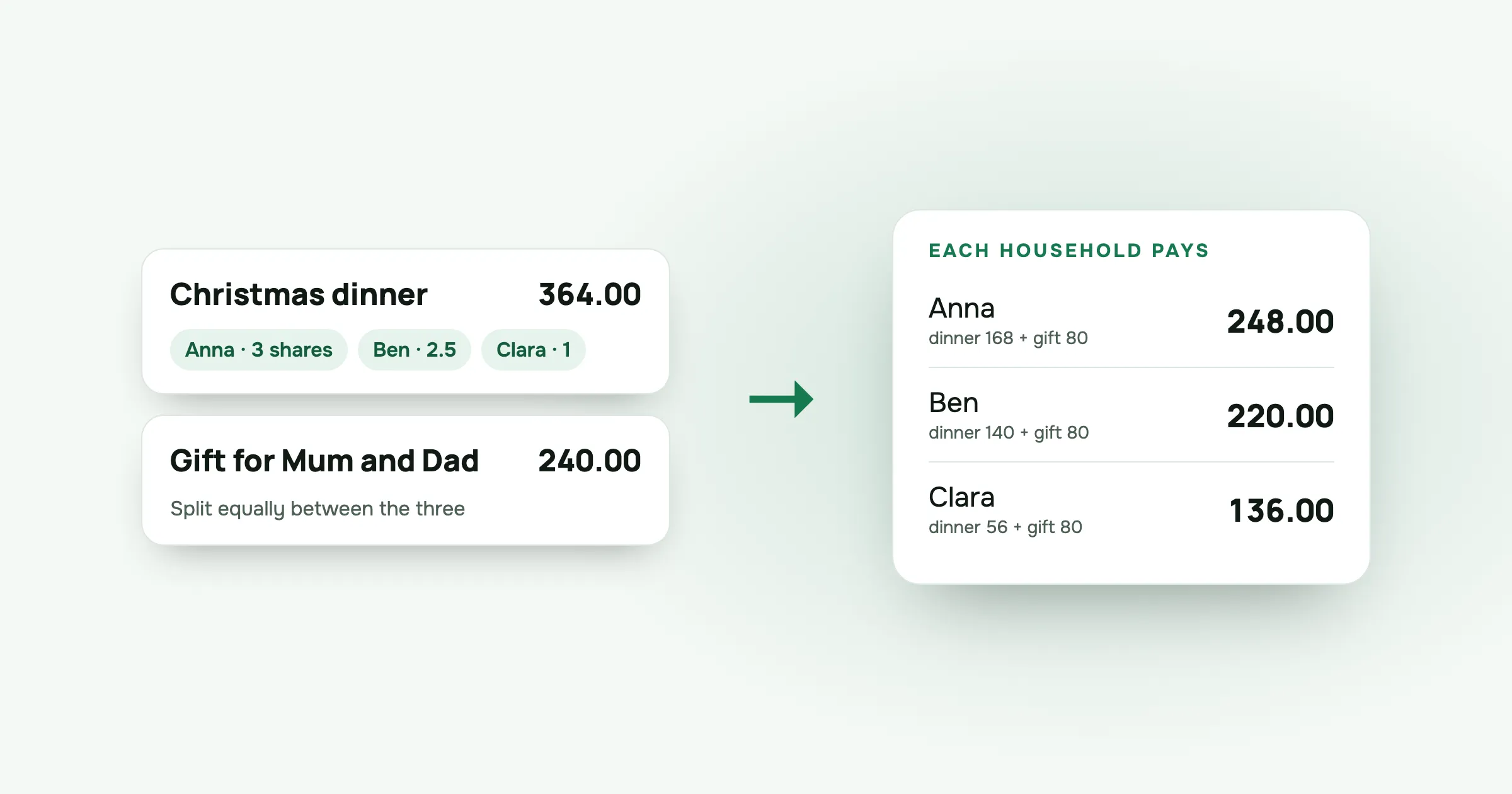
Anna is hosting again. Her household is four people: her, Mark and two children. Her brother Ben is coming with his partner and their son. Her sister Clara is coming on her own, after a three-hour drive. Their parents are coming too, and nobody expects them to pay for anything.
On the 23rd, Anna does the big shop. Ben says he’ll bring the drinks and the cheese. Clara has already bought the present for Mum and Dad, from all three of them. By the 27th, three households have each spent different amounts, and nobody quite wants to be the one who brings it up.
Who pays for Christmas dinner?
There are a few common answers, and each works for some families.
- The host pays, and hosting rotates. Each year a different household hosts and covers the dinner. Over a few years it evens out. This works well when households are similar in size and everyone takes a turn.
- The host pays, and guests bring something. One household brings dessert, another the wine. Simple, but the host’s shop is usually far bigger than a bottle and a pudding.
- Everyone shares the cost. All the food and drink is added up and divided between the households. This is the fairest when the same household hosts every year, or when the households are very different sizes.
If the same person hosts every Christmas, the first option quietly turns into the host paying every year. Sharing the cost is the kinder choice there, even if the host says it’s fine.
Households of different sizes: use shares
Splitting the dinner equally between three siblings sounds fair until you count the people. Anna’s household is four, Ben’s is three and Clara is one. An equal split means Clara pays for her nieces and nephew’s dinners.
Splitting per person is closer, but children usually eat less and drink no wine. The simplest fix is shares:
- each adult counts as 1
- each child counts as 0.5
Anna’s household is 2 adults and 2 children, so 3 shares. Ben’s is 2 adults and 1 child, so 2.5. Clara is 1. If a teenager eats like an adult, count them as 1. A baby can be 0. Agree the numbers once and use them every year.
In split-cash, add one member per household, the person who’ll pay for it, and use Shares on the dinner expenses. Shares accept decimals, so 2.5 works. Relatives who haven’t signed up can be added by name and join later from the invite link.
What about the grandparents?
In most families, the parents are guests and don’t pay. That’s what the shares above assume: Mum and Dad aren’t in the split, so their dinner is shared between the three households by size.
If your parents insist on paying their part, add them as a household with 2 shares. If they’d rather contribute something specific, like the turkey, they can pay for it directly and the rest is split between the siblings.
Gifts for parents: split equally between siblings
The present for your parents works differently from the dinner. It’s a present from the three siblings, so each of them pays the same. Clara shouldn’t pay less for Mum and Dad’s present because she has no children, and Anna shouldn’t pay more because she has two.
Add the gift as its own expense, paid by whoever bought it, and split it equally between the siblings. If someone wants to put in more, use Amounts and type what each person is giving. For a gift on its own, the who owes who calculator does the sum without an account.
Travel stays separate
Clara drives three hours. Ben’s family takes the train. Anna doesn’t travel at all.
Don’t share the travel. Each household chose where it lives and how it gets there, and the costs are too different to be fair in any split. The host household already gives its home, its time and a weekend of cooking and washing up. Leave fuel, trains and parking out of the group.
The exception is a shared journey. If Ben’s family and Clara drive down together in one car, they can split the fuel between themselves.
A worked example
Three households. Their parents are guests and don’t pay.
| Expense | Paid by | Split | Amount |
|---|---|---|---|
| Food for Christmas dinner | Anna | Shares: Anna 3, Ben 2.5, Clara 1 | 286.00 |
| Drinks and cheese | Ben | Shares: Anna 3, Ben 2.5, Clara 1 | 78.00 |
| Gift for Mum and Dad | Clara | Equally between the three | 240.00 |
The dinner. Food and drinks come to 286.00 + 78.00 = 364.00. There are 3 + 2.5 + 1 = 6.5 shares, so one share is 364.00 ÷ 6.5 = 56.00.
- Anna’s household: 3 × 56.00 = 168.00
- Ben’s household: 2.5 × 56.00 = 140.00
- Clara: 1 × 56.00 = 56.00
Check it: 168.00 + 140.00 + 56.00 = 364.00.
The gift. 240.00 split equally between three siblings is 80.00 each.
Each household’s total and balance:
| Paid | Dinner | Gift | Total share | Balance | |
|---|---|---|---|---|---|
| Anna | 286.00 | 168.00 | 80.00 | 248.00 | +38.00 |
| Ben | 78.00 | 140.00 | 80.00 | 220.00 | −142.00 |
| Clara | 240.00 | 56.00 | 80.00 | 136.00 | +104.00 |
Check it: 248.00 + 220.00 + 136.00 = 604.00, and 286.00 + 78.00 + 240.00 = 604.00. The balances add up to zero: 38.00 + 104.00 = 142.00.
Settle up shows two transfers, both from Ben: 38.00 to Anna and 104.00 to Clara.
If the dinner had been split equally between the three siblings, each would have paid about 121.33 for it, and Clara would have paid 65.33 more for her one place at the table.
Making it easy at Christmas
Christmas is the worst time to talk about money, so do as much as possible before and after.
- Agree the method in November. One message to the siblings: dinner by shares, gifts equally, travel separate. Ask everyone to reply.
- Add receipts as you go. Each person adds what they paid from their own phone and attaches a photo of the receipt. Adding expenses needs a connection, so do it before you lose signal in the countryside.
- Settle after Boxing Day. Each person can add How to pay me details. When a transfer arrives, tap Mark as paid.
- Keep it for next year. Archive the group in January. Next Christmas you can look back at what the dinner cost, or export it as a CSV.
Questions people ask
Who pays for Christmas dinner? In many families the host pays and hosting rotates each year. If one household hosts every year, or the households are very different sizes, it’s fairer to add up the food and drink and split it by household size.
How do you split Christmas costs between households of different sizes? Split by shares. Count each adult as 1 and each child as 0.5, add them up per household and split the dinner by those numbers. Two adults with two children get 3 shares.
How should siblings share a Christmas gift for their parents? Split it equally between the siblings, whatever the size of their households. A sibling who comes alone pays the same as one who brings a family of four.
Should travel costs to Christmas be shared? Usually not. Each household pays its own way there, because the distances and choices are different, and the hosts already give their home, their time and their kitchen.
Hosting or travelling this year? Make a group in split-cash for the family and add the first receipt. It’s free, with no ads.
 Sabir Shaykhlislamov Built split-cash