How to split family reunion costs without the organiser paying for everyone
How to split family reunion costs per adult or per household, collect deposits as the organiser, and settle what's left after the day.
Aunt June said yes to organising the reunion in January. By May she had booked the village hall, agreed a menu with a caterer and put down two deposits on her own card. Four other households had said they’d come, a few had sent her money, and she had a spreadsheet with three tabs and no idea who had paid what.
Every family reunion has a June. The job is to make sure she ends up having organised the day, without also having paid for it.
Decide the rule first: per adult or per household
Before asking anyone for money, decide how the cost is divided. There are two common options.
Per household. Each household pays the same. It’s simple, but it’s hard on small households. A widowed uncle coming alone pays the same as a family of five.
Per adult, with children at half. Each adult counts as 1, each child as 0.5, and babies as 0. Teenagers usually count as adults, because they eat like adults. It’s a common choice and the one this post uses.
Whatever you choose, put it in the first message about money, so nobody learns the rule from their bill.
Who’s in each household
In split-cash there’s no separate “household”. The practical way to model one is to add one member per household, usually the person who’ll pay, and give them the household’s shares. You can add people by name before they’ve signed up, and their costs are waiting when they join.
For June’s reunion:
- June: June and her husband, 2 adults = 2 shares
- Paul: 2 adults and 2 children = 3 shares
- Rita: coming alone = 1 share
- Omar: 2 adults, a teenager and a child = 3.5 shares
- Lena: 2 adults and 1 child = 2.5 shares
That’s 12 shares: 10 adults at 1 and 4 children at 0.5.
Collecting deposits as the organiser
Halls and caterers want money months ahead, long before anyone knows the final bill. The organiser shouldn’t carry that alone.
Ask each household for a fixed deposit when they confirm, say 150.00. When it arrives, record it in the group as a payment from that household to the organiser, the same way you’d record someone paying back a debt. It reduces what that household owes later.
This does two useful things:
- The organiser can see at a glance who has paid a deposit and who hasn’t.
- Nobody has to remember the deposit at the end. The app already counts it.
Add How to pay me details to your profile, like an IBAN or a payment link, so relatives can copy them instead of asking. For anyone who hasn’t paid, the Remind button opens your phone’s share menu with a message ready to send.
Record costs as they happen
When the organiser pays the hall or the caterer, add it straight away as an expense paid by them, split by Shares with each household’s number. Attach a photo of the invoice, so anyone who wonders where 1,560.00 went can see it.
If someone else pays for part of the day, like Paul booking the bouncy castle, he adds it as paid by him. Everyone’s costs end up in one place, whoever paid.
If a household drops out after paying a deposit, either keep the deposit if the costs were already committed, or record a payment back to them. Agree this in the first message too.
A worked example
Five households, 12 shares. Every expense is split by Shares: June 2, Paul 3, Rita 1, Omar 3.5, Lena 2.5.
| Expense | Paid by | Amount |
|---|---|---|
| Village hall | June | 720.00 |
| Catering | June | 1,560.00 |
| Bouncy castle and games | Paul | 240.00 |
| Total | 2,520.00 |
2,520.00 ÷ 12 shares = 210.00 per share. That’s the cost per person: 210.00 per adult and 105.00 per child.
Each household’s share:
- June: 2 × 210.00 = 420.00
- Paul: 3 × 210.00 = 630.00
- Rita: 1 × 210.00 = 210.00
- Omar: 3.5 × 210.00 = 735.00
- Lena: 2.5 × 210.00 = 525.00
Check it: 420.00 + 630.00 + 210.00 + 735.00 + 525.00 = 2,520.00.
Paul, Rita, Omar and Lena each paid June a 150.00 deposit in spring, recorded as payments.
Balances, which is what each household paid in expenses and deposits minus its share:
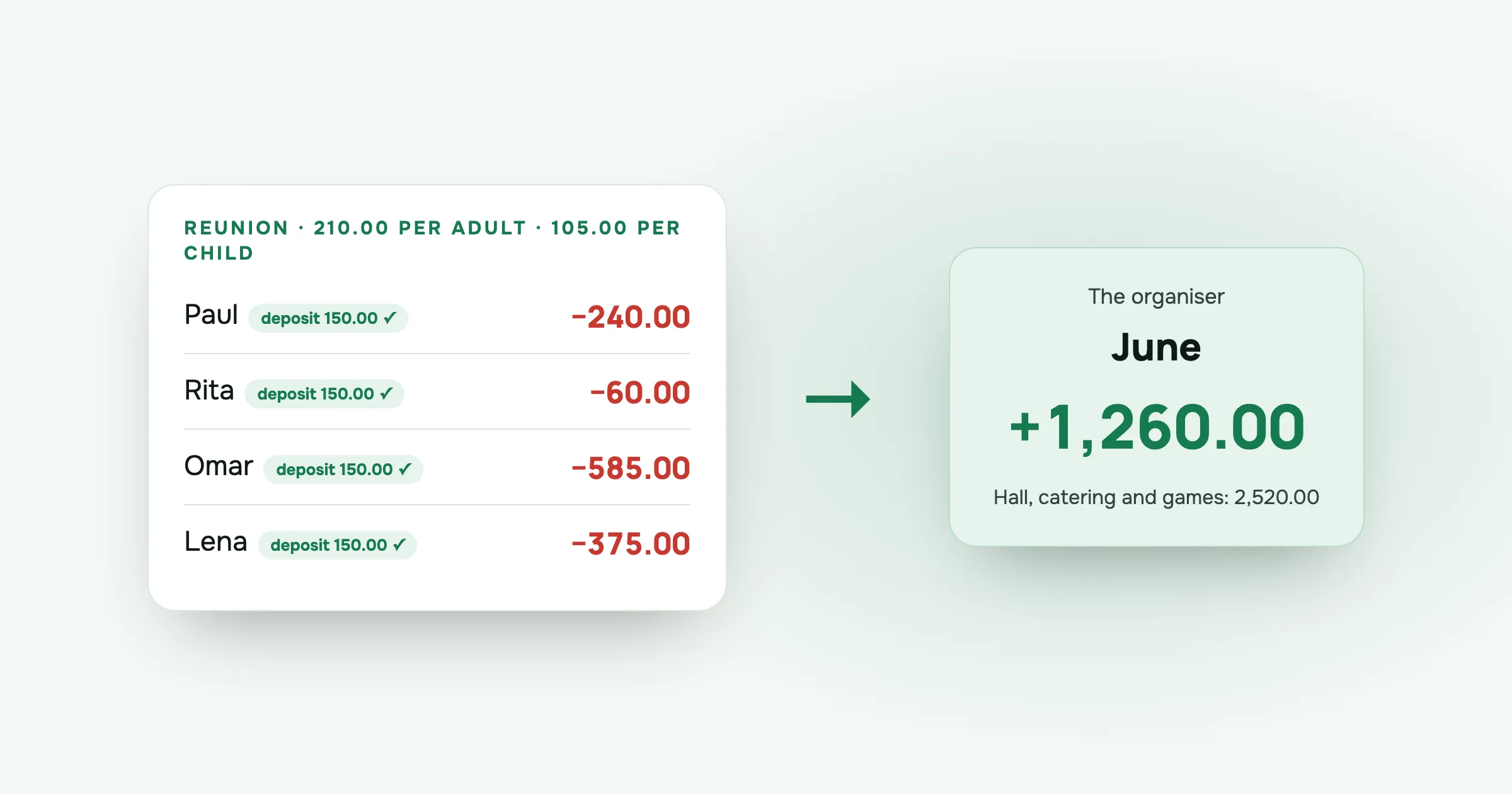
- June: paid 2,280.00 in costs, share 420.00, and received 600.00 in deposits: 2,280.00 − 420.00 − 600.00 = +1,260.00
- Paul: 240.00 + 150.00 − 630.00 = −240.00
- Rita: 150.00 − 210.00 = −60.00
- Omar: 150.00 − 735.00 = −585.00
- Lena: 150.00 − 525.00 = −375.00
They add up to zero: 240.00 + 60.00 + 585.00 + 375.00 = 1,260.00, which is what June is still owed.
Settle up shows four transfers, all to June: 240.00 from Paul, 60.00 from Rita, 585.00 from Omar and 375.00 from Lena. When money arrives, she taps Mark as paid. If Omar sends 300.00 now and the rest next month, mark the partial payment and the remaining 285.00 stays on the list.
Compare that with a flat split per household: 2,520.00 ÷ 5 = 504.00 each. Rita, coming alone, would pay 504.00 instead of 210.00, and Omar’s family of four would pay 504.00 instead of 735.00.
Tips for the organiser
- Set the deposit low enough that nobody hesitates. It’s there to cover early bookings, not to collect everything up front.
- Keep optional extras separate. If only some families go to the Saturday dinner at the pub, add it as its own expense and untick the households that don’t.
- Don’t chase in the family chat. Remind people one at a time. Nobody likes being named in front of the cousins.
- Export when it’s done. A CSV export gives the next organiser a list of what everything cost. Then archive the group so it’s out of the way until the next reunion.
For more on getting the money in without awkwardness, see how to ask friends to pay you back.
Questions people ask
How do you split family reunion costs? Add up the hall, food and activities, then split the total per adult, with children counting as half. One person per household pays for everyone in it, so each household’s part follows from how many adults and children it brings.
Should a family reunion be split per adult or per household? Per adult is fairer when households are different sizes. Per household means a single aunt pays the same as a family of five. Many families split per adult and count children as half.
How does a family reunion treasurer collect deposits? Ask each household for a fixed deposit when they confirm, and record each one as a payment to the organiser. After the event, enter the real costs and each household pays or receives only the difference.
How much does a family reunion cost per person? Divide the total cost by the number of adults plus half the number of children. In the example in this post, a 2,520.00 reunion with 10 adults and 4 children comes to 210.00 per adult and 105.00 per child.
Organising the next reunion? Make a group in split-cash, add one person per household and record deposits as they come in. It’s free, with no ads.
 Sabir Shaykhlislamov Built split-cash