How to split groceries on holiday when everyone eats differently
How to split the big first shop, top-ups, alcohol and leftovers on holiday, with a vegan, a non-drinker and a child in the group.
The first afternoon at the villa, Leo pushes a trolley through a supermarket the size of an aircraft hangar. Hana adds three bottles of wine. Mia, who is vegan, quietly puts back the chorizo Leo picked up for her. Omar doesn’t drink and wonders, silently, why he’s helping to carry a crate of beer. Sara’s seven-year-old wants cereal with a cartoon on the box.
The receipt comes to 420.00, on Leo’s card. By the end of the week there have been three more shops, and nobody can say who ate what.
The method is simple: split the food everyone eats, and pull out the few things only some people have.
The big first shop
Don’t add the first big shop as one 420.00 expense split six ways. Look at the receipt and split it into a few pieces:
- Shared food. Everything the whole group eats or uses. This is most of it.
- Meat and fish, if someone in the group doesn’t eat them.
- Alcohol. Always separate, unless every single person drinks.
Add each piece as its own expense, all paid by the same person. The total paid is still 420.00, but each piece is shared by the right people.
At the till, ask for the alcohol to be rung through as a separate payment, so you don’t have to add up lines later. Either way, attach a photo of the receipt to the expense.
Top-up shops
Then come the small shops: bread in the morning, more milk, ice, things for a barbecue. They’re the ones people forget. Add each the same way, with drinks separate, from the shop or that evening at the latest. A 33.00 bakery run is easy to remember on Tuesday and impossible to remember on Saturday.
If small daily purchases are too fiddly to record one by one, some groups use a small cash kitty for bread and coffee, and record the larger shops in the app.
Vegetarians, vegans and non-drinkers
A vegan shouldn’t pay for the steaks, and a non-drinker shouldn’t pay for the wine. Those two costs are large and clearly belong to some people, so separate them. Beyond that, keep it simple:
- Meat and fish get their own expense, and the vegetarian or vegan is unticked.
- Alcohol gets its own expense, and non-drinkers are unticked. Soft drinks and juice stay in the shared food.
- Everything else is shared. Don’t separate oat milk from cow’s milk or vegan cheese from cheddar. The amounts are small, everyone eats some of everyone else’s food, and the differences even out over a week.
If one person needs something expensive that only they eat, such as gluten-free bread every day, they can buy it themselves and keep it out of the group. Agree that on the first day.
Kids
Children eat less than adults and drink no wine, so a common rule is:
- Babies and toddlers: 0. They eat from their parents’ plates.
- Children: 0.5.
- Teenagers: 1.
In split-cash you don’t need to add the child as a member. Give the parent their child’s share on top of their own. Sara is on holiday with her son Max, who is seven, so in the shared food Sara gets 1.5 shares and everyone else gets 1. Choose Shares when you add the expense. Shares accept decimals, so 1.5 works.
Max still counts as 0 for alcohol, so Sara gets 1 share there, like any other adult who drinks. Things only Max uses, such as nappies or his cereal, can go on an expense with only Sara ticked.
Leftovers at the end
On the last morning there’s half a bag of rice, some olive oil and an unopened bottle of gin. Opened food and small amounts don’t need recording. Share them out, leave them for the next guests, or let whoever has space take them.
Anything worth real money is different, because the others paid for part of something they won’t have. The fix is to edit the original expense: take the bottle’s price out of the shared alcohol, and add it as its own expense paid by the same person, with only the person taking it ticked. The payer is still credited for the full receipt, and the bottle is charged to the person who has it.
A worked example
Five adults and one child spend a week in a villa: Hana, Leo, Mia, Omar, and Sara with Max. Mia is vegan. Omar doesn’t drink. Sara has 1.5 shares in the food.
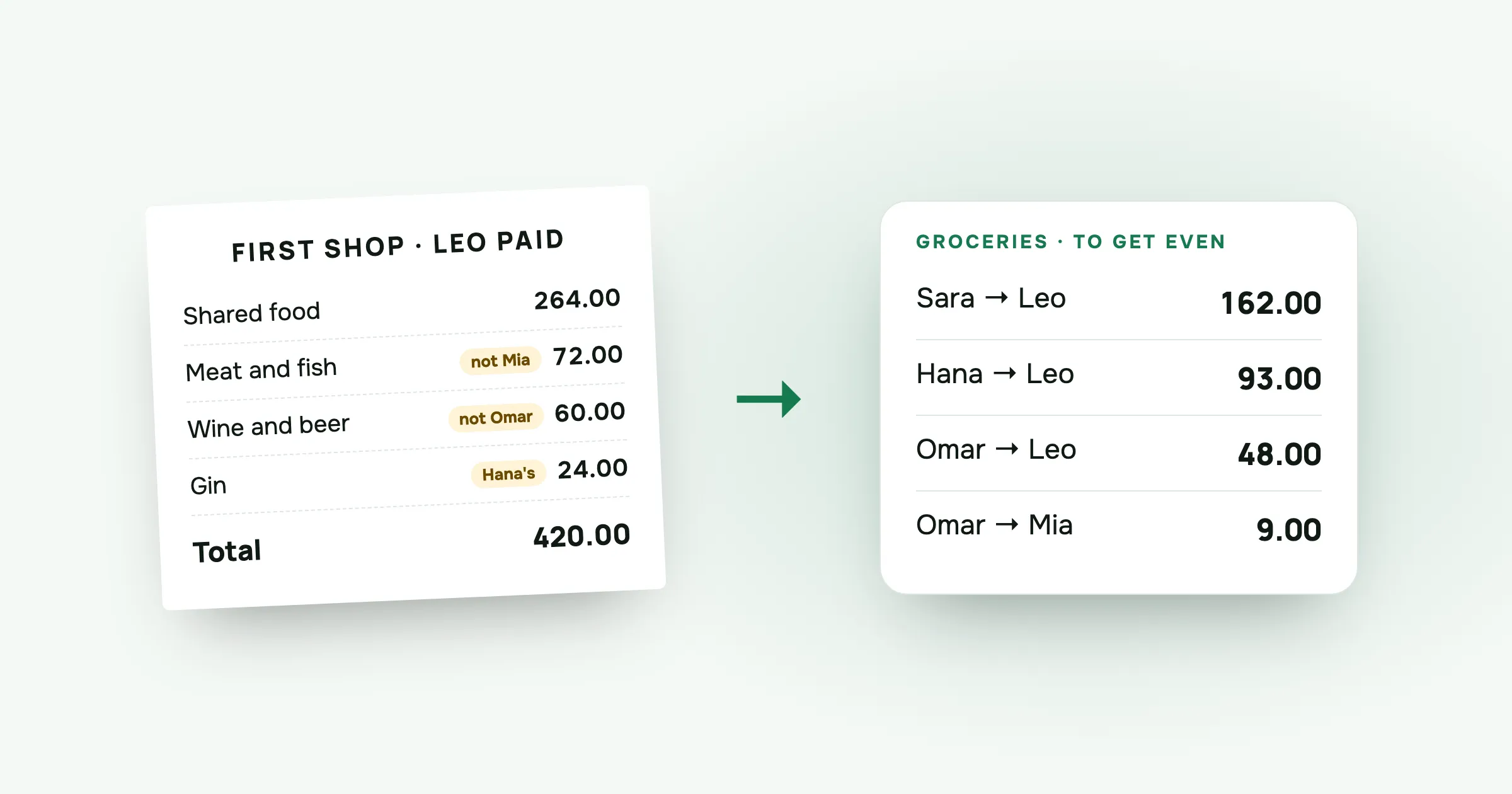
The big first shop: 420.00, paid by Leo. He adds it as four expenses.
- Shared food, 264.00. Shares: Hana 1, Leo 1, Mia 1, Omar 1, Sara 1.5. That’s 5.5 shares, so 264.00 ÷ 5.5 = 48.00 a share. Sara pays 72.00.
- Meat and fish, 72.00. Mia is unticked. 4.5 shares, so 72.00 ÷ 4.5 = 16.00 a share. Sara pays 24.00.
- Wine and beer, 60.00. Omar is unticked. Four drinkers at 15.00 each.
- Gin, 24.00. Hana is taking it home, so only Hana is ticked.
Leo first entered the drinks as 84.00, gin included. On the last morning, when Hana packed the unopened bottle, he edited that expense down to 60.00 and added the 24.00 gin for Hana alone.
Check it: 264.00 + 72.00 + 60.00 + 24.00 = 420.00.
Top-up shop: 110.00, paid by Mia. All shared food. 110.00 ÷ 5.5 = 20.00 a share, and Sara pays 30.00.
More drinks: 48.00, paid by Hana. Four drinkers at 12.00 each.
Bakery runs: 33.00, paid by Omar. 33.00 ÷ 5.5 = 6.00 a share, and Sara pays 9.00.
| Food | Meat, fish | Drinks | Gin | Top-up | More drinks | Bakery | Total | |
|---|---|---|---|---|---|---|---|---|
| Hana | 48.00 | 16.00 | 15.00 | 24.00 | 20.00 | 12.00 | 6.00 | 141.00 |
| Leo | 48.00 | 16.00 | 15.00 | 20.00 | 12.00 | 6.00 | 117.00 | |
| Mia | 48.00 | 15.00 | 20.00 | 12.00 | 6.00 | 101.00 | ||
| Omar | 48.00 | 16.00 | 20.00 | 6.00 | 90.00 | |||
| Sara and Max | 72.00 | 24.00 | 15.00 | 30.00 | 12.00 | 9.00 | 162.00 |
Check it: 141.00 + 117.00 + 101.00 + 90.00 + 162.00 = 611.00. The shops add up to 420.00 + 110.00 + 48.00 + 33.00 = 611.00.
Balances, what each person paid minus their share:
- Hana: 48.00 − 141.00 = −93.00
- Leo: 420.00 − 117.00 = +303.00
- Mia: 110.00 − 101.00 = +9.00
- Omar: 33.00 − 90.00 = −57.00
- Sara: 0.00 − 162.00 = −162.00
They add up to zero. Settle up shows four transfers: Sara pays Leo 162.00, Hana pays Leo 93.00, and Omar pays Leo 48.00 and Mia 9.00.
Omar paid nothing towards the wine and beer, and Mia paid nothing towards the meat. Nobody had to price a single carton of milk.
If you only need the sums for one shop and don’t want to make a group, the trip expense splitter works without an account.
Questions people ask
How do you split groceries on holiday? Split the shared food equally, or by shares if there are children. Keep alcohol, and anything only some people eat, as separate expenses so you can untick the people who didn’t have it.
How do you split groceries with a vegetarian or vegan? Put the meat and fish on their own expense and untick the vegetarian or vegan. Everything else, including bread, vegetables, pasta and coffee, stays shared. Don’t price every carton of oat milk, because small differences even out over a week.
Should non-drinkers pay for the alcohol in the food shop? No. Add the wine and beer as a separate expense and untick anyone who doesn’t drink. If the alcohol was on the same receipt as the food, add up those lines and enter them as their own expense.
What happens to leftover food at the end of a holiday? Opened food and small leftovers are usually shared out or left behind. If someone takes home something worth real money, like an unopened bottle, edit the original expense to take its price out, and add it as an expense for that person alone.
Heading to the supermarket on day one? Make a group in split-cash first, so the big shop goes in before the receipt gets lost. It’s free, with no ads.
 Sabir Shaykhlislamov Built split-cash