How to split boat charter costs on a sailing holiday
Split the charter fee, APA, skipper and damage waiver on a sailing trip with friends, and what to do when part of the APA comes back.
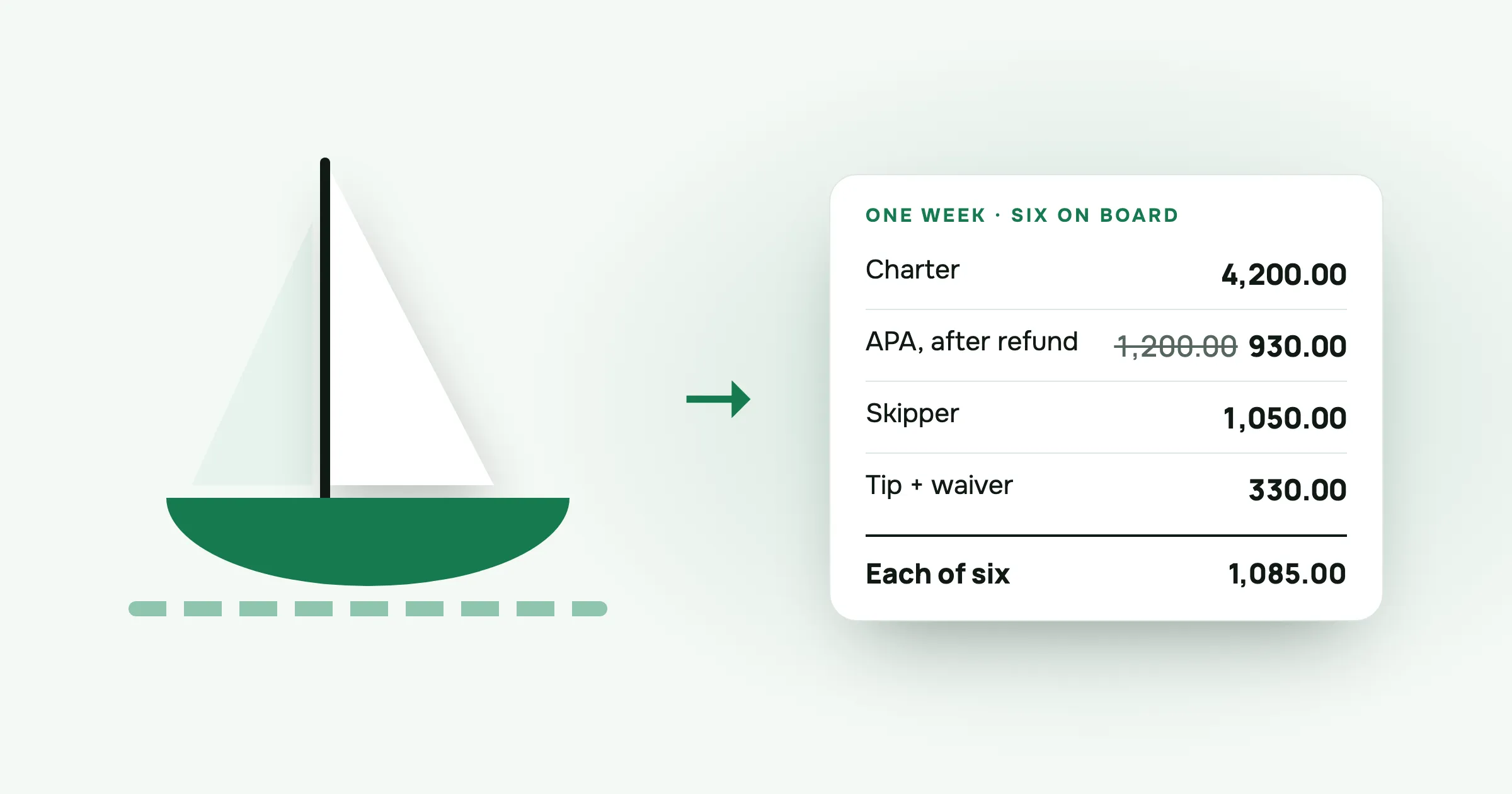
Six friends, one 45-foot yacht, a week in the islands. Sam paid the charter fee in January. At check-in someone hands over the APA, someone pays the damage waiver, and the skipper wants paying. Seven days later the unspent APA comes back in an envelope, and nobody is sure whose it is.
Sailing holidays are easier to split than they look, because almost everything is a cost of the whole boat. The only part that confuses people is the APA.
What goes into the pot
- Charter fee. The price of the boat for the week.
- APA (advance provisioning allowance). Money paid to the charter company at the start for fuel, marina fees and food. A kitty the company holds for you.
- Skipper fee and tip.
- Damage waiver or security deposit.
- Extras like a paddleboard or final cleaning.
Everyone sleeps on the same boat and goes to the same places, so all of these are split equally. If one couple has the bigger cabin with its own head, you can give them a little more with Shares, as with better rooms in a rental. Most crews don’t bother.
The APA, and what to do when money comes back
The APA is the one cost whose final amount you don’t know when you pay it. You hand over 1,200.00 on day one, fuel, marina nights and provisions are paid from it, and on the last day the unused part comes back.
There are two correct ways to record the refund in split-cash:
- Edit the expense. Lucy paid the 1,200.00 APA, so she adds it as an expense paid by her, split equally. When 270.00 comes back to her, she edits the expense to 930.00. The group’s real cost was 930.00 and everyone’s share updates.
- Record payments. Keep the expense at 1,200.00. The refund is worth 45.00 to each of the six, and Lucy received all of it. In effect each of the other five has handed Lucy 45.00, so you record a 45.00 payment to Lucy from each of them. The balances come out the same, but that’s five entries for transfers that never happened.
Use the first one. Editing the amount says exactly what happened: the APA cost the group 930.00, and Lucy paid it. Put “APA 1,200 minus 270 refund” in the description so the change is clear.
If the refund lands with someone else, they pass it to Lucy, then she edits the expense. If the APA runs out mid-week and you top it up, add the top-up as a second expense.
Skipper, deposit and waiver
The skipper fee is a cost of the boat, split equally. The skipper isn’t in the group, since they aren’t sharing costs with you. The tip works the same way: one person hands it over and records it. Cash tips are easy to forget, so add it the moment the envelope changes hands.
A refundable security deposit isn’t a cost. If the company keeps part of it for a scraped hull, add that part as an expense paid by the card holder, split equally. A non-refundable damage waiver is a cost from the start, split like the charter fee.
A worked example
Six friends: Sam, Lucy, Tom, Nina, Omar and Priya. One week, one skipper.
| Cost | Paid by | Amount |
|---|---|---|
| Charter fee | Sam | 4,200.00 |
| APA, 1,200.00 less 270.00 refunded | Lucy | 930.00 |
| Skipper, 7 days at 150.00 | Tom | 1,050.00 |
| Skipper tip | Sam | 150.00 |
| Damage waiver | Sam | 180.00 |
| Total | 6,510.00 |
Check it: 4,200.00 + 930.00 + 1,050.00 + 150.00 + 180.00 = 6,510.00.
Split equally between six, that’s 6,510.00 ÷ 6 = 1,085.00 each.
Now the balances, which is what each person paid minus their share:
- Sam paid 4,200.00 + 150.00 + 180.00 = 4,530.00. He is owed 4,530.00 − 1,085.00 = 3,445.00.
- Lucy paid 930.00. She owes 1,085.00 − 930.00 = 155.00.
- Tom paid 1,050.00. He owes 1,085.00 − 1,050.00 = 35.00.
- Nina, Omar and Priya paid nothing yet. They owe 1,085.00 each.
Check it: 155.00 + 35.00 + 3 × 1,085.00 = 155.00 + 35.00 + 3,255.00 = 3,445.00, exactly what Sam is owed.
Settle up shows five transfers, all to Sam. Only one person is owed money, so that’s the fewest possible.
Had Lucy left the APA at 1,200.00, each share would have been 45.00 too high and she’d have kept the 270.00 refund on top.
Food and drinks ashore
Harbour dinners and drinks at the marina bar aren’t in the APA. Record them as you go, like on any trip with friends, and untick anyone who skipped a dinner. For uneven bills, see the restaurant bill guide.
Before you sail
- Make the group when you book. Friends can be added by name before they sign up.
- Pick one person to hold the APA and the deposit.
- Agree the skipper tip and any cabin premium before anyone is on board.
- If the charter is in another currency, enter the amount your card was charged. Each group has one currency and split-cash doesn’t convert.
Questions people ask
What is the APA on a boat charter? The advance provisioning allowance is money you pay the charter company up front to cover fuel, marina fees and food during the trip. It works like a kitty. Whatever isn’t spent comes back to you at the end.
How do you record the APA refund? Record the APA as one expense paid by whoever paid it. When the unused part comes back, edit the expense down to the amount actually spent. That keeps everyone’s share correct with no extra entries.
Is the skipper fee split between everyone? Yes. The skipper fee and the skipper’s tip are costs of the whole boat, so split them equally between everyone on board, like the charter fee.
Is the security deposit a cost? No. A refundable deposit only becomes a cost if part of it is kept for damage. Then split the part that was kept like any other boat cost. A non-refundable damage waiver is a cost from the start and is split equally.
Just booked the boat? Make a group in split-cash, add the first charter payment and send the link to the crew. It’s free, with no ads.
 Sabir Shaykhlislamov Built split-cash