How to split vacation costs between two families with kids
A fair way for two or three families of different sizes to share a holiday house, food and days out, with kids counted by age.
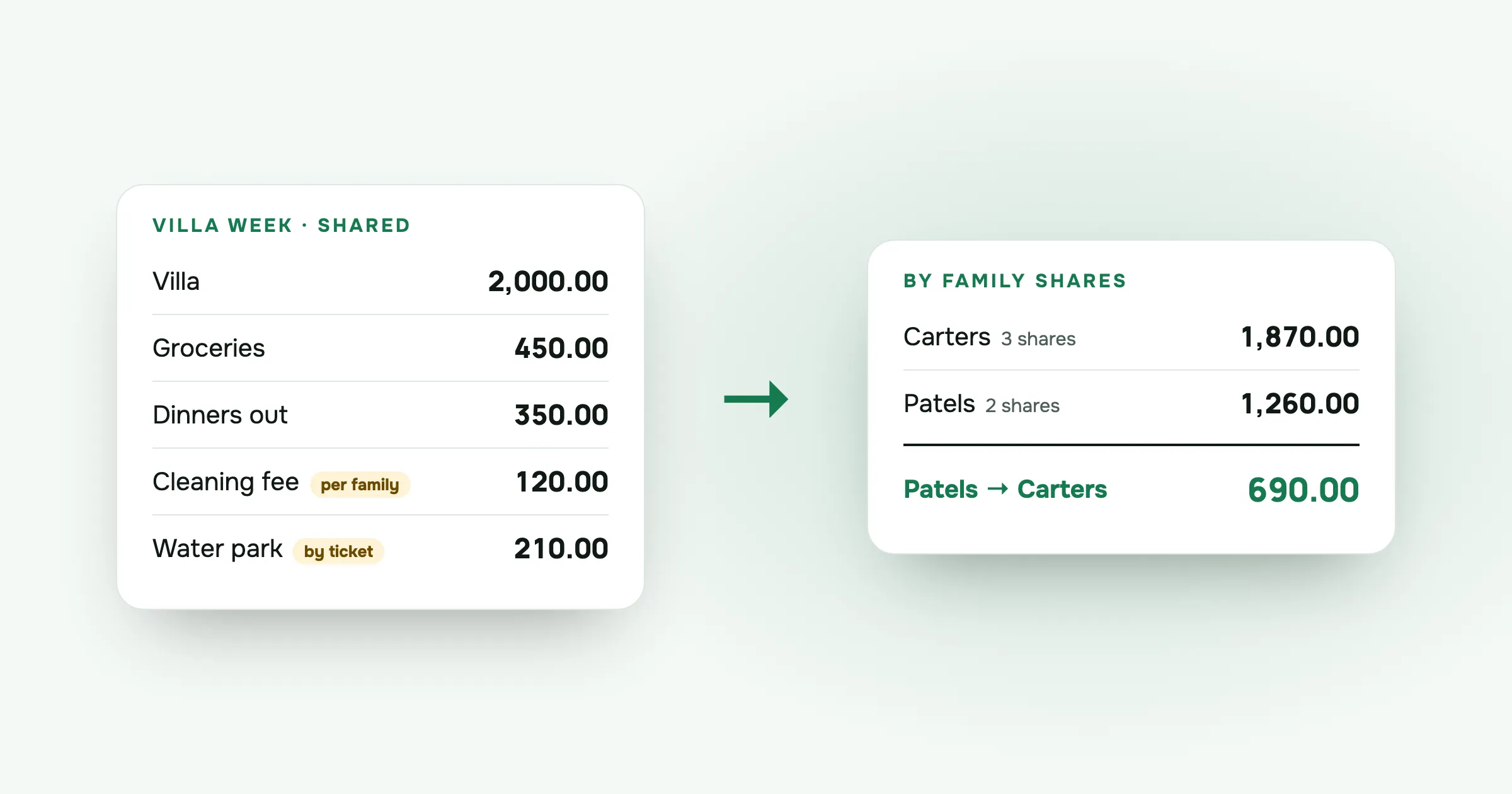
The Carters and the Patels have been friends since their eldest children started school together. This summer they’ve rented a villa for a week. The Carters are Jess, Dan, Lily, who is ten, and Noah, who is seven. The Patels are Amir, Nina and their one-year-old, Kai.
At the booking stage, Dan said “let’s just go halves”. Nina did the maths in her head. Halves would mean two adults and a baby paying the same as two adults and two hungry school-age children, for a week of groceries and restaurant dinners. She didn’t say anything, because nobody wants to be the one who brings it up.
Two families on holiday together is easier when that conversation happens at the start, with numbers everyone can see.
Per family or per person?
Per family. Each family pays the same, whatever its size. It’s quick, and it’s fair when the families are much the same: two adults and two kids each, say.
Per person. Each person counts, so a bigger family pays more. It’s fairer when the families are different sizes, which is most of the time.
Most groups end up using per person for nearly everything, and per family for the odd cost that doesn’t change with the number of people:
- Per person: groceries, restaurant meals, tickets, and usually the house itself, since a family of five needs more beds than a family of three.
- Per family: a cleaning fee, a parking permit, the deposit for a pool heater. They cost the same whether three people use them or five.
How much does a child count?
Children eat less, get cheaper tickets and don’t drink wine, so counting them as a full person overcharges their parents. A common rule:
- Babies and toddlers, up to about 3: 0. They eat from their parents’ plates and get in free.
- Children, about 4 to 11: 0.5.
- Teenagers, 12 and up: 1. A fourteen-year-old eats more than most adults.
Agree the age limits before the trip. For the villa:
- The Carters: 2 adults + 2 children at 0.5 = 3 shares
- The Patels: 2 adults + 1 baby at 0 = 2 shares
That’s 5 shares in total. The Carters pay 3 parts of each shared cost and the Patels pay 2. With a third family, add its number to the total: a single parent with a twelve-year-old would be 2 more shares, for 7 in all.
Two ways to set it up in split-cash
There’s no “family” button. You choose how to model each family.
One member per family
Add one person from each family to the group: Jess for the Carters and Nina for the Patels. When you add a shared expense, choose Shares and give each family its number: Jess 3, Nina 2. Shares accept decimals, so a family of 2.5 works too.
When Dan or Amir pays for something, enter it as paid by Jess or Nina. It’s the family’s money either way.
This is the simplest setup. There are only two balances, and at the end of the week Settle up shows a single transfer between the families. With three families, it’s at most two.
Every person as a member
You can also add each person: Jess, Dan, Lily, Noah, Amir, Nina and Kai. Children can be added by name and never need to sign up. Give each person their own share in every expense, 1 for adults and 0.5 for Lily and Noah, and untick Kai.
This helps when family members often do different things. If only Dan and Lily go on the diving trip, you untick everyone else and the cost lands exactly where it belongs.
The downside is the balances. Lily and Noah will show as owing money, and Jess and Dan will owe each other, so settling up takes more steps.
For most families, one member per family is enough. Use per-person members when the adults in a family pay separately, or when the group splits up a lot.
Costs that belong to one family
Each family’s own flights, a day trip one family takes alone, ice creams for your own kids: keep them out of the group. Only record what the families agreed to share.
A worked example
The Carters have 3 shares and the Patels have 2. Jess is the Carters’ member and Nina is the Patels’.
| Expense | Paid by | Split | Carters | Patels |
|---|---|---|---|---|
| Villa: 2,000.00 | Carters | Shares, 400.00 a share | 1,200.00 | 800.00 |
| Groceries: 450.00 | Patels | Shares, 90.00 a share | 270.00 | 180.00 |
| Dinners out: 350.00 | Carters | Shares, 70.00 a share | 210.00 | 140.00 |
| Cleaning fee: 120.00 | Patels | Per family, equal | 60.00 | 60.00 |
| Water park: 210.00 | Carters | Amounts | 130.00 | 80.00 |
Each per-share figure is the cost divided by 5. For the villa, 2,000.00 ÷ 5 = 400.00.
The water park charged 40.00 for an adult and 25.00 for a child, and Kai got in free. Dan bought all the tickets on one card, so Jess added them as paid by the Carters, using Amounts: 2 × 40.00 + 2 × 25.00 = 130.00 for the Carters, and 2 × 40.00 = 80.00 for the Patels.
Each family’s total:
- Carters: 1,200.00 + 270.00 + 210.00 + 60.00 + 130.00 = 1,870.00
- Patels: 800.00 + 180.00 + 140.00 + 60.00 + 80.00 = 1,260.00
Check it: 1,870.00 + 1,260.00 = 3,130.00, and 2,000.00 + 450.00 + 350.00 + 120.00 + 210.00 = 3,130.00.
What each family paid:
- Carters: 2,000.00 + 350.00 + 210.00 = 2,560.00
- Patels: 450.00 + 120.00 = 570.00
Balances, which is what each family paid minus its share:
- Carters: 2,560.00 − 1,870.00 = +690.00
- Patels: 570.00 − 1,260.00 = −690.00
They add up to zero. Settle up shows one transfer: Nina pays Jess 690.00.
Going halves on everything would have cost each family 3,130.00 ÷ 2 = 1,565.00. The Patels would have paid 305.00 more than their share, covering part of the food, beds and tickets used by the Carters’ children.
Different arrival days
If one family arrives two days late, multiply each family’s shares by the nights it stays. A family of 3 shares staying 7 nights gets 21, and a family of 2 shares staying 5 nights gets 10. Enter those numbers under Shares. To count each person’s nights instead, the split by nights calculator works without an account.
During the week
Make the group before you leave, send the invite link to the other parents and add the villa deposit as soon as it’s paid. Attach photos of the supermarket receipts to the expenses. On the last evening, open Settle up. If Jess has filled in How to pay me, Nina can copy her bank details and pay from her phone.
For a holiday with grandparents rather than another family, see how to split costs on a family holiday with grandparents.
Questions people ask
How do you split vacation costs between two families? Give each family a number of shares based on who is in it, with adults at 1 and children at 0.5 or 0 depending on age. Split shared costs like the house, food and meals out by those shares, and keep each family’s own costs out of the split.
Should families split holiday costs per family or per person? Per person, with children counted as part of a person, for anything that grows with the number of people, such as food, meals out, tickets and usually the house. Per family only for costs that stay the same however many people come, such as a cleaning fee.
How do kids count when families share holiday costs? A common rule is 0 for babies and toddlers, 0.5 for children and 1 for teenagers. Agree the age limits before the trip, so nobody has to argue about one child’s appetite.
Do you need to add every child to an expense app? No. The simplest way is one member per family, with that family’s shares. Adding every person also works, and helps if family members often do different things, but it gives more balances to settle.
Booking a holiday with another family? Make a group in split-cash, add one person per family and send the link. It’s free, with no ads.
 Sabir Shaykhlislamov Built split-cash