How to track sports team expenses: a team kitty without the cash
Track pitch hire, kit and tournament fees for a five-a-side or pub league team, split each game between whoever played, and settle up once a season.
It’s Thursday night, ten minutes before kick-off. Tom has paid the pitch again, the fourth week in a row, and is standing by the gate asking who has the six quid. Two people say they’ll send it later. One of them sent it last week, he thinks. Raj, who bought the new shirts in August, has stopped bringing it up.
Most informal teams run on goodwill and one person’s bank card. It works until that person gets tired of chasing. A simple record of who paid for what fixes most of it.
What a team actually pays for
For a five-a-side side or a pub league team, the costs usually fall into a few groups:
- Pitch hire or match fees, every week, usually paid by one person who books.
- Kit: shirts, a ball, bibs, a first aid kit.
- League or tournament entry, once or twice a season.
- Extras: referee fees, an end-of-season meal, a ball that went over the fence.
The weekly costs and the one-off costs need different handling, because not everyone plays every week.
One group per season
Make one split-cash group for the season and send the invite link to the team chat. Players who aren’t keen on signing up can be added by name, and their balance is tracked all the same. When the season ends and everyone has settled, archive the group and start a new one.
One group per season keeps the numbers small and gives you a natural point to settle. Nobody wants to discover a balance from three seasons ago.
Pitch hire: split between whoever played
Charge each game only to the people who played. If the pitch costs 42.00 and six of you turned up, that’s 7.00 each. If all seven came, it’s 6.00 each.
In split-cash, whoever paid the pitch adds it after the game as an expense paid by them, with everyone ticked. Then they untick whoever didn’t play. It takes a few seconds, and the person who was ill that week isn’t paying for a game they missed.
If a regular sub joins from time to time, add them to the group by name. They’re ticked only for the games they play.
Kit and shared gear: split equally
Shirts, balls and bibs are used by the whole squad, so split them equally across everyone, including players who only turn up now and then. If one player gets a shirt with a name printed on it and the others don’t, add the printing as a separate expense for that player only.
Tournament and league fees
Split a tournament fee between whoever entered. If five of you play in a weekend tournament, the entry fee is split five ways, and the two who were away that weekend are unticked.
A season’s league fee is usually different. It covers every game, so most teams split it across the whole squad.
When one person pays the pitch every week
This is the most common setup, and the most likely to go wrong. Tom books and pays every week. Within a month he’s out of pocket by a meaningful amount, spread over several people in small bits.
Recording each game fixes the tracking. Settling regularly fixes the rest. Pick a rhythm, once a month or at the end of the season, and stick to it. Tom adds his bank details under How to pay me, so nobody has to ask for them. When it’s time, he can use Remind, which opens the phone’s share menu so he can send the reminder through the team chat or a message.
One thing to be clear about: split-cash doesn’t collect money, hold a kitty or charge anyone’s card. It tracks who paid, who owes, and how much. Players pay each other directly, the way they would anyway.
A worked example
A pub league team of seven: Tom, Raj, Marco, Dev, Sean, Luis and Ollie. Over the first few weeks:
| Expense | Paid by | Amount | Split between | Each |
|---|---|---|---|---|
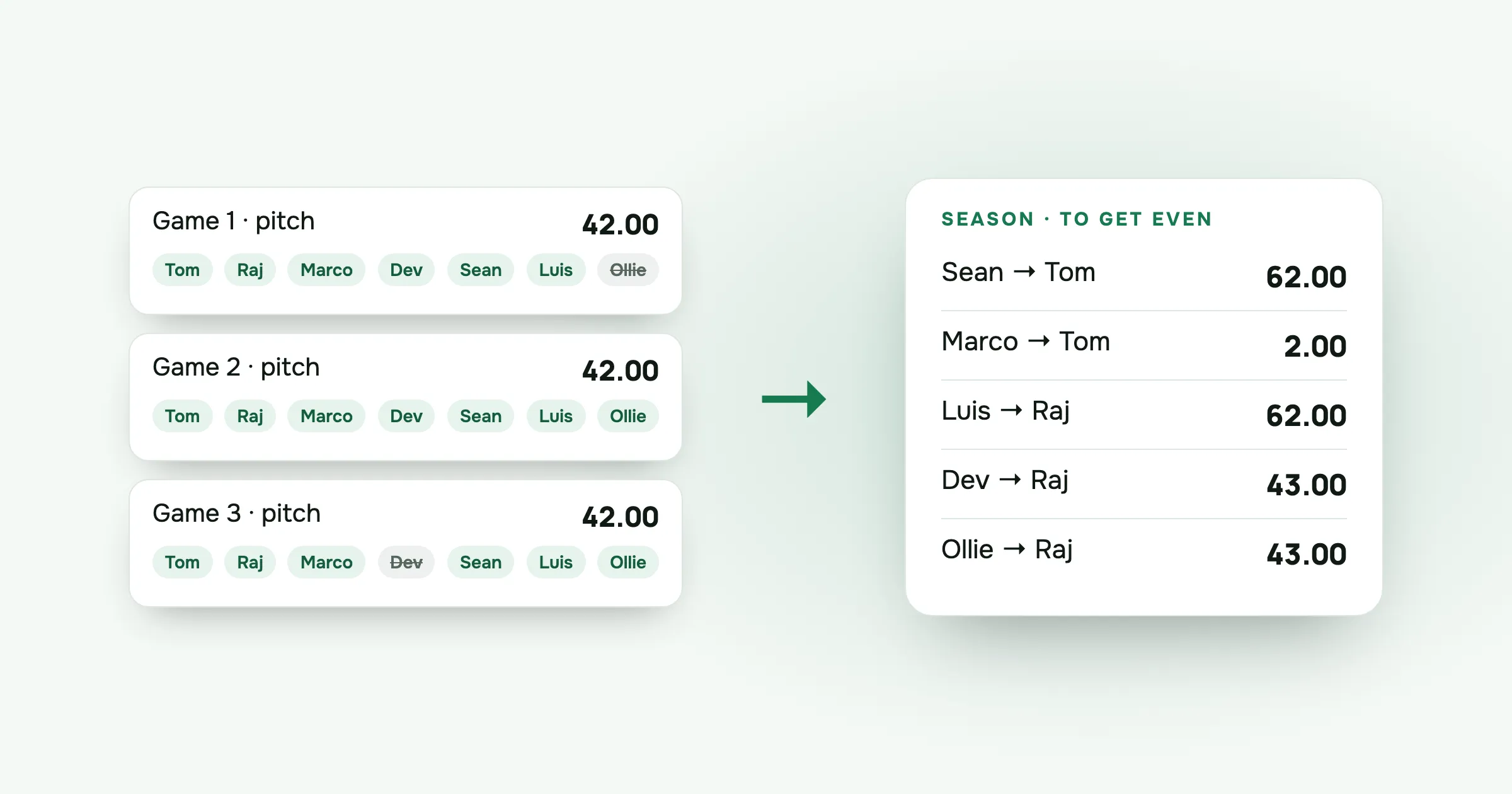
| Game 1 | Tom | 42.00 | six (not Ollie) | 7.00 |
| Game 2 | Tom | 42.00 | all seven | 6.00 |
| Game 3 | Tom | 42.00 | six (not Dev) | 7.00 |
| Shirts | Raj | 210.00 | all seven | 30.00 |
| Tournament entry | Marco | 60.00 | Tom, Raj, Marco, Sean, Luis | 12.00 |
| Total | 396.00 |
Check the total: 42.00 + 42.00 + 42.00 + 210.00 + 60.00 = 396.00.
Each player’s share:
- Tom, Raj, Marco, Sean and Luis: 7.00 + 6.00 + 7.00 + 30.00 + 12.00 = 62.00 each
- Dev: 7.00 + 6.00 + 30.00 = 43.00
- Ollie: 6.00 + 7.00 + 30.00 = 43.00
Check it: 5 × 62.00 + 43.00 + 43.00 = 310.00 + 86.00 = 396.00.
Balances, what each person paid minus their share:
- Tom paid 126.00. 126.00 − 62.00 = +64.00
- Raj paid 210.00. 210.00 − 62.00 = +148.00
- Marco paid 60.00. 60.00 − 62.00 = −2.00
- Sean and Luis: −62.00 each
- Dev and Ollie: −43.00 each
Check it: 64.00 + 148.00 − 2.00 − 62.00 − 62.00 − 43.00 − 43.00 = 0.00.
Settle up clears the lot in five transfers, along these lines: Sean sends Tom 62.00, Marco sends Tom 2.00, Luis sends Raj 62.00, and Dev and Ollie each send Raj 43.00. Tom gets his 64.00 back and Raj gets his 148.00.
Without a record, Dev and Ollie would probably have paid the same as everyone else, and Marco would think he was owed money for the tournament when he’s actually 2.00 short.
As each transfer comes in, tap Mark as paid. If Sean sends half now and half on payday, mark the part he sent, and the rest stays on the plan.
Kitty or record?
Some teams prefer a cash kitty: everyone puts in 20.00 at the start of the month and the captain pays the pitch from it. That works if everyone plays every week. It gets unfair when people miss games, and someone still has to hold the cash and chase top-ups. There’s more on that in travel kitty or app, and the same reasoning holds for a team.
Recording each game takes less effort than collecting cash every week, and it charges people for what they actually played.
Questions people ask
How do you split pitch hire between players? Split each game between the people who actually played. In split-cash, add the pitch as an expense paid by whoever booked it and untick anyone who missed that game, so they don’t pay for it.
Should a sports team use a cash kitty? A cash kitty means one person collecting money every week and chasing whoever forgot. Recording each cost and settling once a month or once a season is less work, and players who miss games aren’t charged for them.
How do you handle players who miss games? Leave them out of that game’s pitch fee. Shared costs like kit or a season’s league fee can still be split across the whole squad, since everyone benefits from them.
Does split-cash collect money from players? No. split-cash doesn’t hold money or charge cards. It tracks who paid what and who owes whom, and players pay each other directly by bank transfer or however the team usually pays.
Paying the pitch again this week? Make a group for the season and send the link to the team chat. It’s free, with no ads.
 Sabir Shaykhlislamov Built split-cash